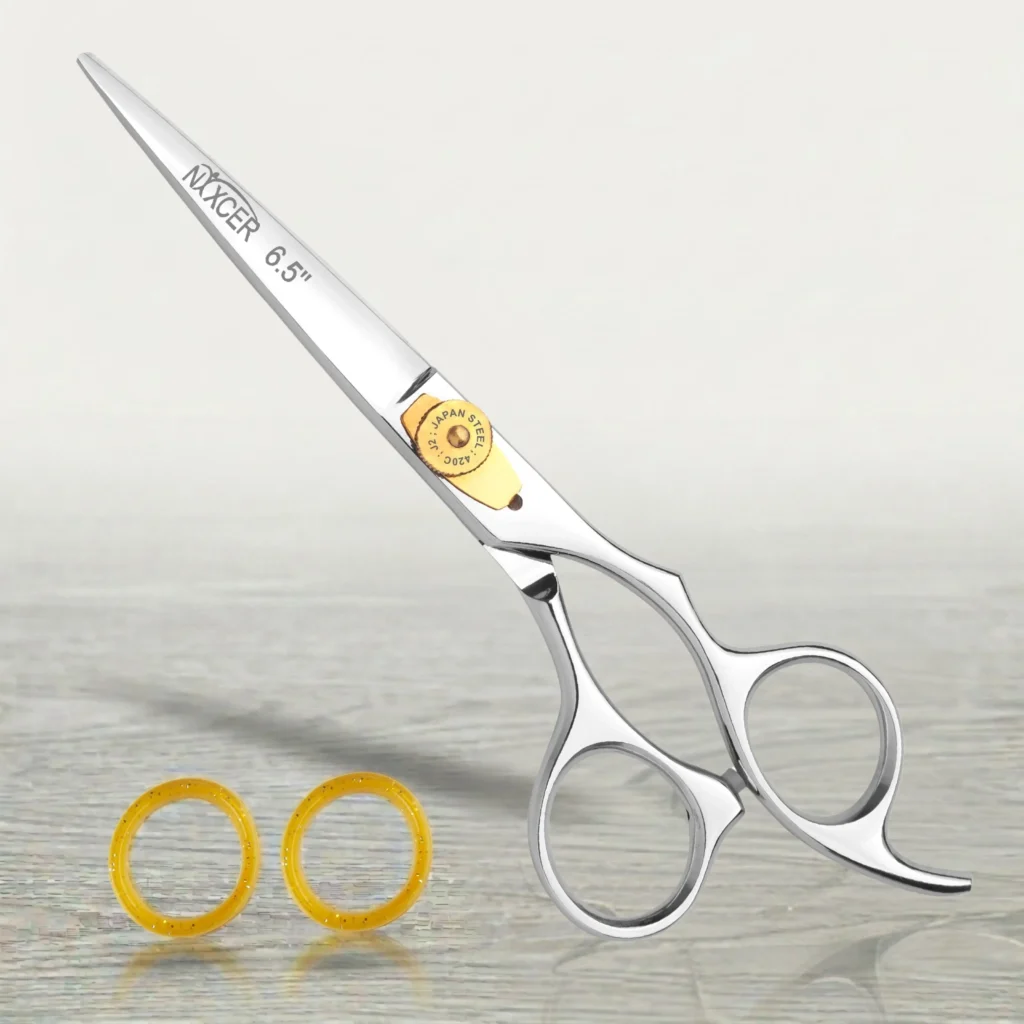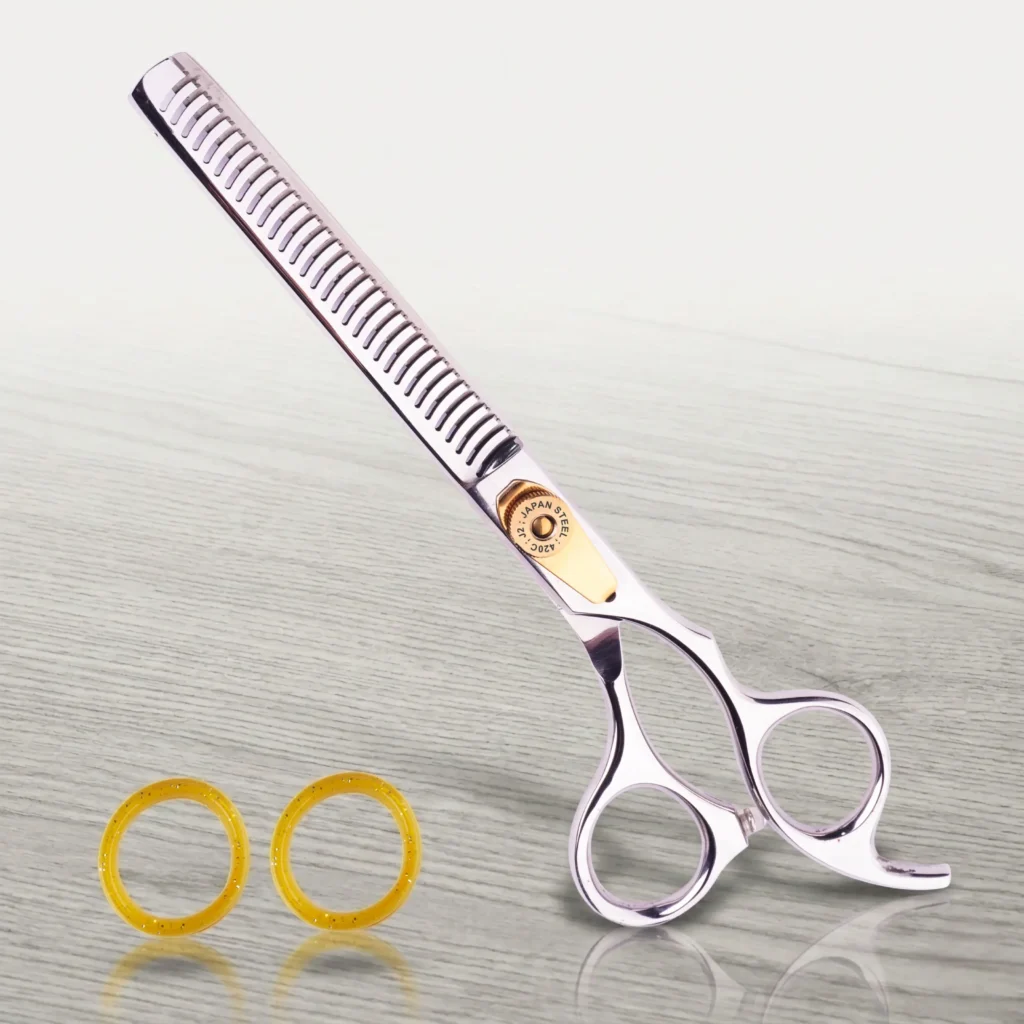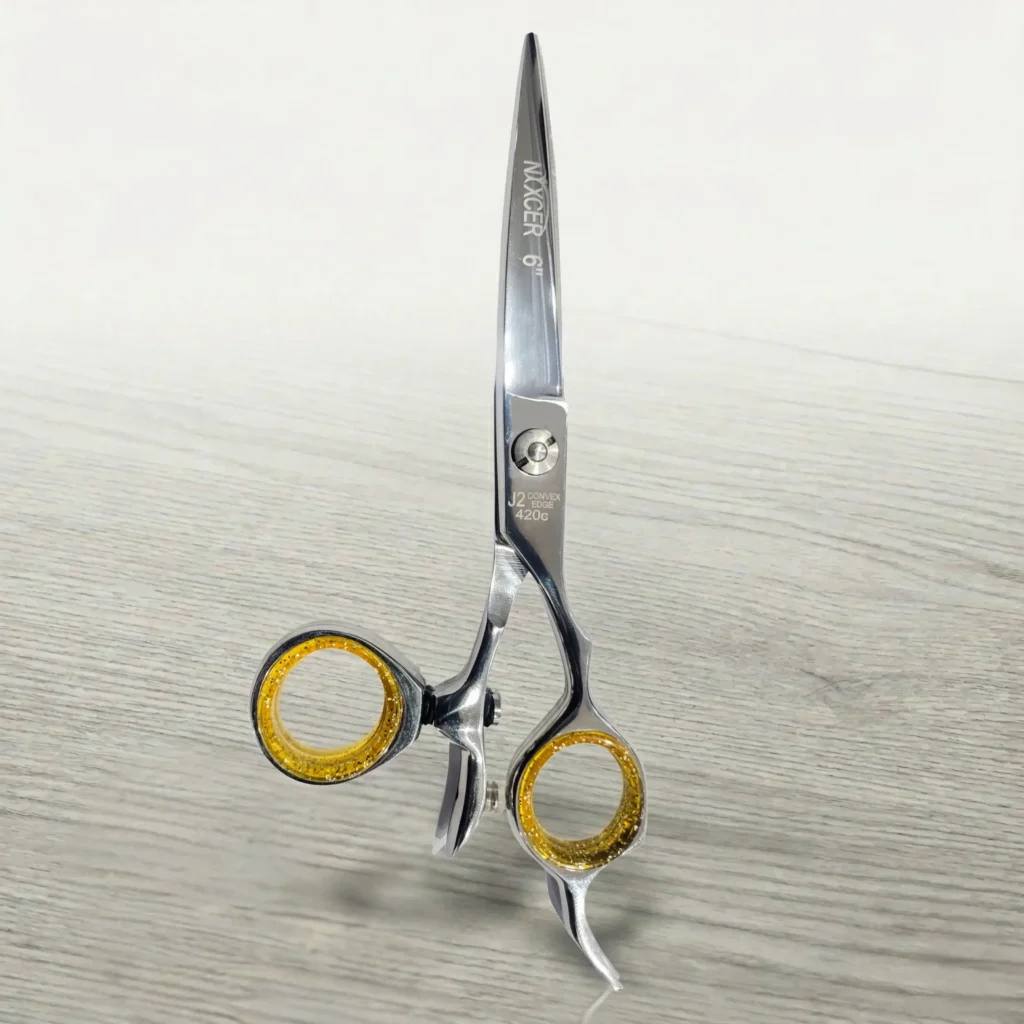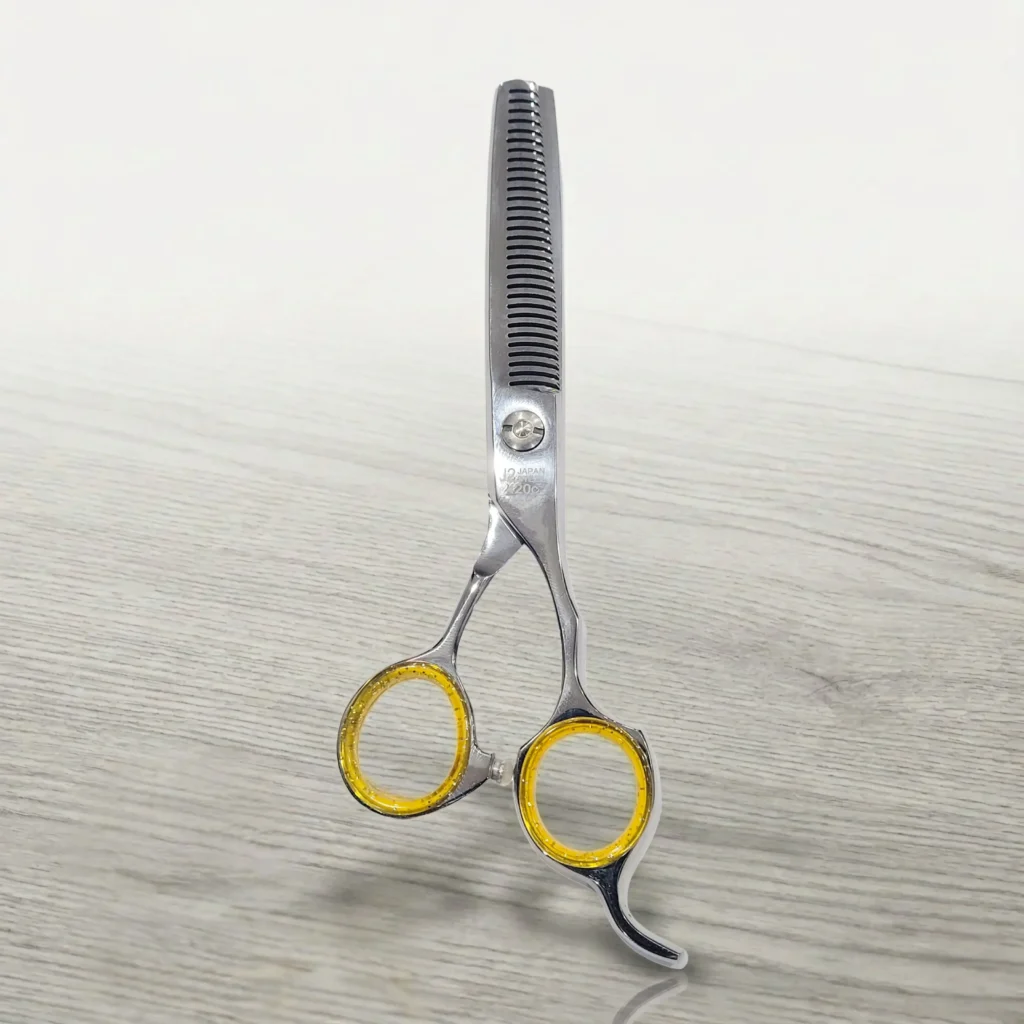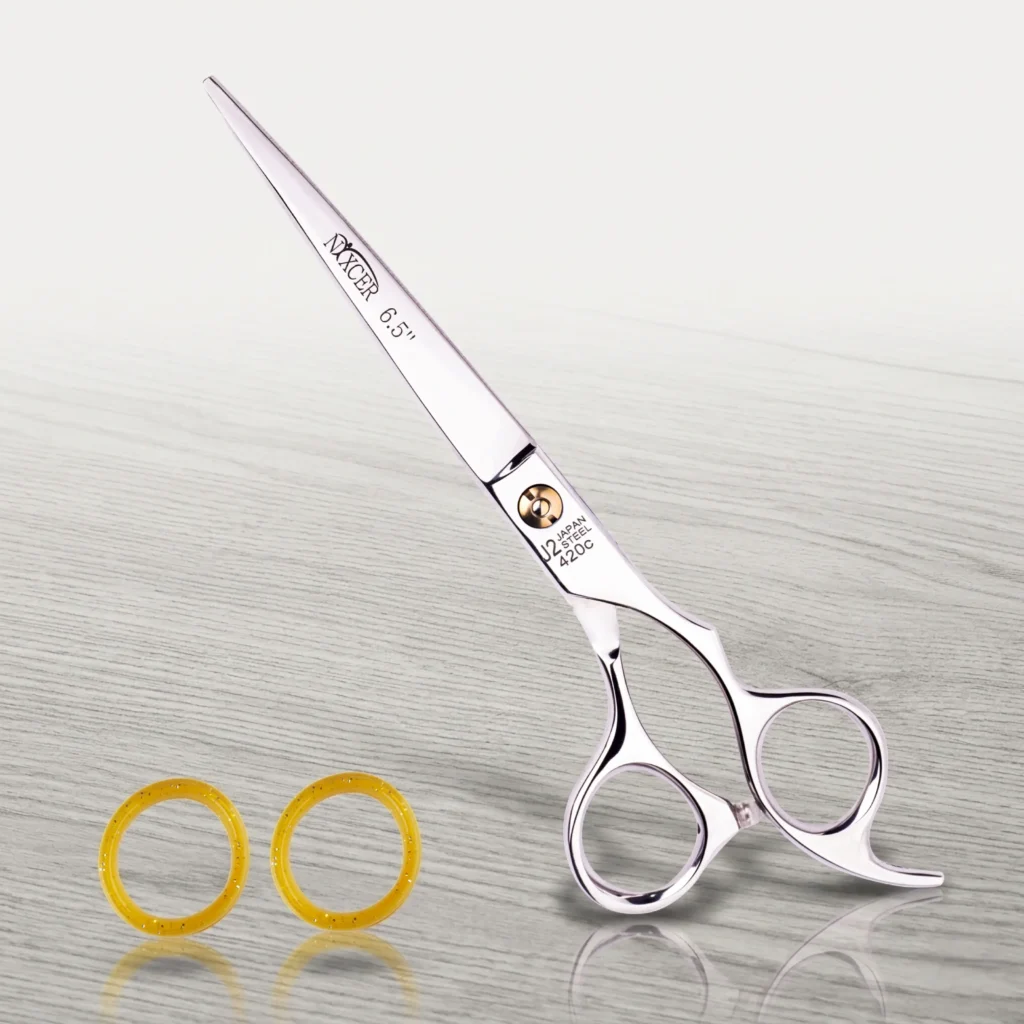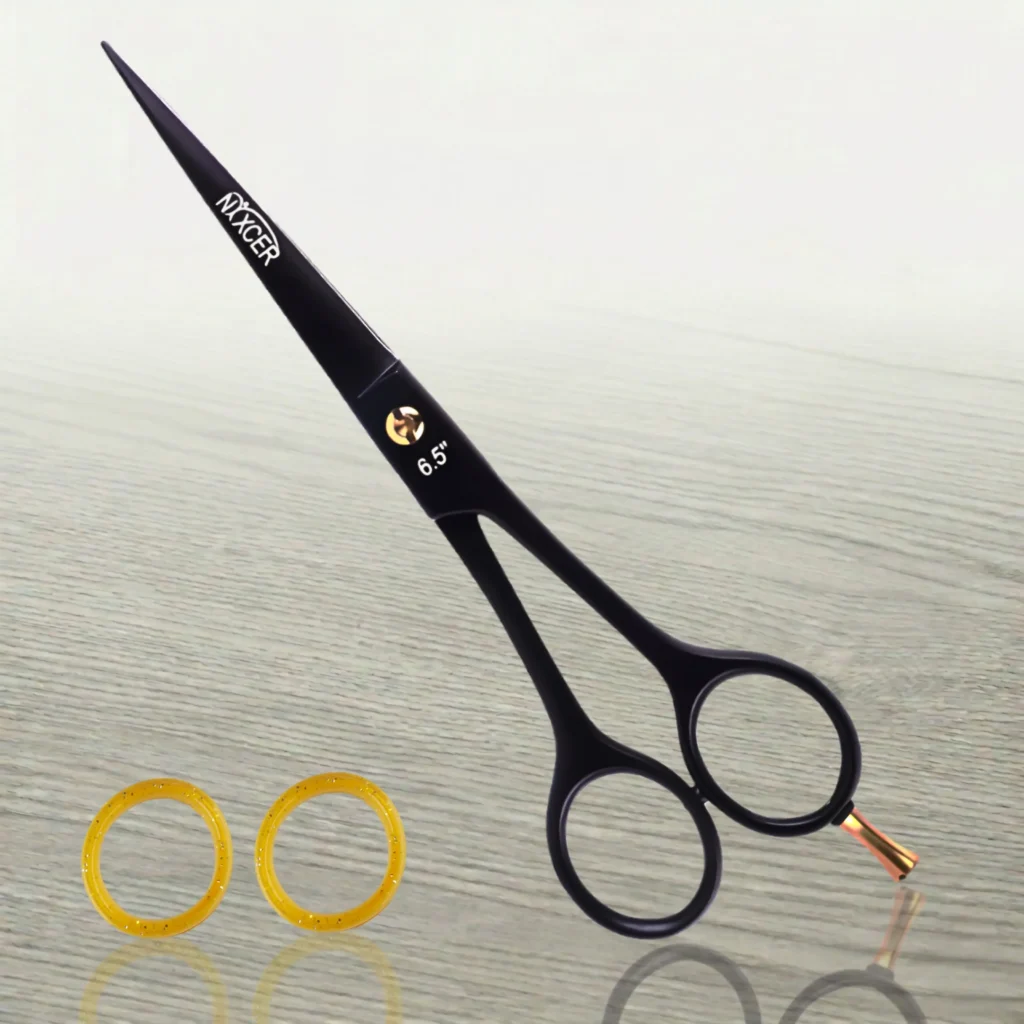
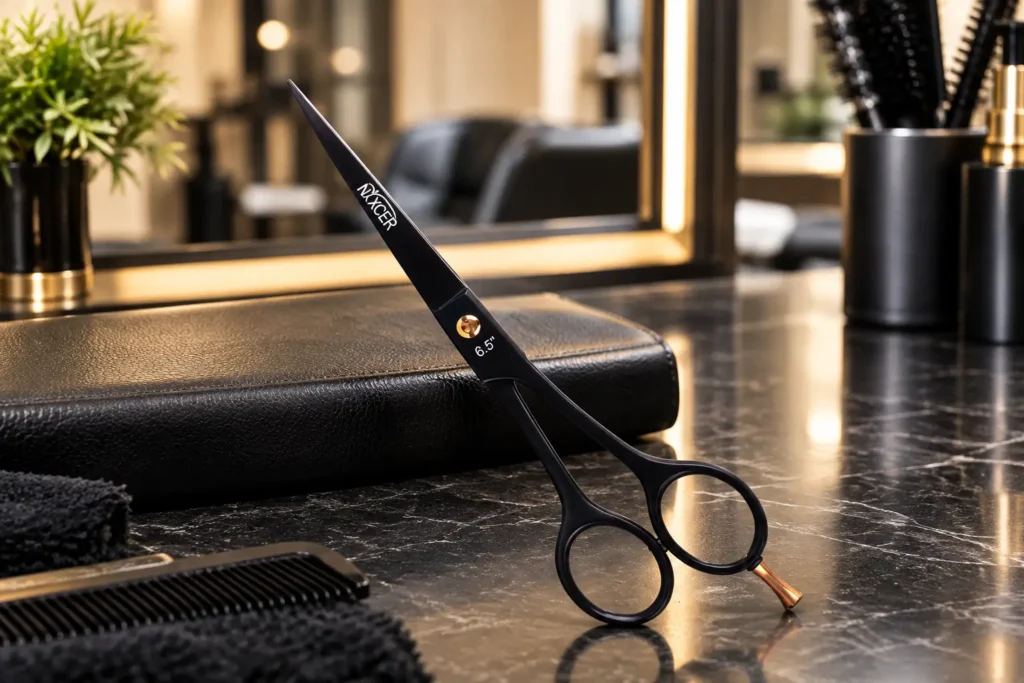
Shear quality matters because professional hair cutting scissors must keep two blades meeting at the correct angle and pressure through thousands of repeated openings and closures. Steel provides the foundation, but material alone does not determine performance. Edge geometry, grinding, blade alignment, pivot tension, balance, handle fit, quality control, and servicing all affect how cleanly and predictably the shear cuts.
A well made shear should close smoothly, hold or release the hair as the technique requires, and remain controllable from pivot to tip. A poor match or poorly maintained tool may fold, push, pull, or catch hair even when its product listing uses premium language. The useful question is not whether a pair sounds expensive. It is whether its complete design fits the stylist, technique, workload, and maintenance plan.
Quick Answer
High quality hair cutting scissors combine suitable blade steel and heat treatment with precise edge geometry, accurate blade alignment, stable tension, balanced weight, comfortable handle fit, and reliable manufacturing. These factors support clean cutting and consistent control. Price, country associated with the steel, cobalt content, or a Rockwell hardness number can inform the choice, but none proves quality by itself.
What Professional Shear Quality Means
Hair shears are precision cutting tools. Their edges do not work like two independent knives. The blades move past each other and must maintain controlled contact along the cutting path. If the set, ride line, pivot, or edge has been manufactured or serviced incorrectly, the tool may feel rough or fail to cut cleanly in part of the blade.
Quality can be assessed through several connected properties:
- The material can support the intended edge without excessive wear or fragility.
- Heat treatment produces suitable hardness and consistency.
- Blade shape and edge angle suit the cutting technique.
- The blades are ground, set, and aligned accurately.
- The pivot holds stable tension while allowing smooth movement.
- The handle and balance fit the user.
- The maker provides clear specifications and appropriate service guidance.
One impressive specification cannot compensate for weakness in another area. Hard steel with poor grinding is not a high quality shear. A sharp convex edge on an uncomfortable handle is not the right professional tool for that user.
Quality Factors to Compare
| Quality factor | What to verify | Why it matters |
| Steel and heat treatment | Identified alloy or steel family with credible hardness and manufacturing information | Supports edge stability wear resistance corrosion resistance and serviceability |
| Edge geometry | Convex beveled semi convex or micro serrated edge suited to the technique | Controls sharpness cutting feel hair movement and sharpening requirements |
| Blade shape and line | Straight curved narrow broad or sword style blade matched to the task | Affects hair control slicing behavior detail access and cutting power |
| Alignment and set | Even blade meeting stable ride line and clean tip closure | Helps the shear cut consistently from pivot to tip without folding hair |
| Pivot and tension | Smooth movement with tension that follows maker guidance | Controls blade contact and the force required to operate the shear |
| Balance and handle fit | Predictable weight distribution correct handedness and comfortable rings | Supports control without requiring an excessive grip or constant repositioning |
| Finish and quality control | Clean surfaces sound assembly and consistent operation | Indicates whether manufacturing and final inspection were completed carefully |
| Service support | Correct sharpening method parts warranty and repair access | Protects the original geometry and extends useful service life |
Steel Is the Foundation
Blade steel influences how fine an edge can be formed, how long it can resist wear, how it responds to impact, and how it should be sharpened. Professional shears commonly use stainless cutlery steels and specialized alloys. Some include cobalt or use powder metallurgy, but the alloy name must be interpreted with its heat treatment and blade design.
Manufacturer information is more useful than a vague claim such as Japanese steel. That phrase may describe an origin, grade, supplier, marketing category, or only a claimed material association. Look for a specific steel designation, hardness information, edge type, and service instructions when available.
JOEWELL describes blade material as one of the main elements in scissor quality and explains that controlled heat treatment is used to obtain consistent properties in stainless blade materials. JAGUAR also presents steel, cutting edge, tension, and ergonomics as linked quality factors. Both sources support the same practical conclusion: material matters, but the finished shear depends on how that material is processed and assembled.
Hardness Needs Context
Rockwell hardness measures resistance to indentation under a defined test method. It can help compare materials when the manufacturer reports the correct scale and a credible value. A higher number may support edge retention, but hardness does not directly measure sharpness, toughness, corrosion resistance, balance, or the quality of grinding.
Very hard material can support a fine edge, yet edge geometry and handling determine whether that edge is durable in real use. A lower value is not automatically poor if the shear is designed for a different cutting feel or easier servicing. Treat hardness as one specification within the complete design.
The Rockwell hardness guide for hair cutting scissors explains how to read this measurement without turning one number into a quality grade.
Edge Geometry Controls the Cutting Action
The edge is where steel, grinding, and technique meet. Convex edges use a refined curved profile and can provide a smooth action for precision work and slicing. Beveled edges have a more defined angle and may offer a stable, controlled feel. Micro serrations can help grip hair, while specialized texturizing teeth control how much hair is removed.
No edge is best for every job. A highly polished convex shear may be excellent for slide cutting but must be sharpened by someone who can preserve that geometry. A beveled or micro serrated design may hold hair securely during straight cutting yet feel unsuitable for a moving technique.
Read the guide to different hair cutting scissor blades and the comparison of convex and beveled edges before selecting an edge.
Blade Shape Must Match the Technique
Blade line affects how hair behaves as the scissors close. JOEWELL explains that a straighter blade line helps hold hair without sliding, while greater curvature encourages sliding and supports slicing. Blade width changes the distribution of strength: wider or sword style blades can provide more power, while narrow tips support detailed work.
This is why one premium shear does not replace every specialized tool. A straight stable blade may suit a blunt perimeter. A curved blade may support moving cuts. A short narrow point may be easier to control around a fringe or ear. A longer broad blade can cover a wide section efficiently when the stylist can control it.
Quality means the blade performs its intended task consistently. Versatility is useful, but a design should not be called superior merely because it attempts to perform every technique.
Alignment and Blade Contact Matter
The two blades must meet accurately through the closure. Their set, curvature, ride area, pivot, and tips work together. If the blades lose correct contact, hair may bend, fold, push, or escape even when the visible edge looks sharp.
A simple inspection can reveal obvious problems. Open and close the clean shear slowly in good light. Listen and feel for sudden catches, scraping, or an unstable pivot. Check that the tips meet as designed and that the blade action remains consistent. Do not force the blades together or attempt to bend them back into alignment.
Alignment and set are technician level adjustments. Home grinding, aggressive tightening, or bending can remove metal and permanently change the shear. When performance varies along the blade, stop using it on clients and ask a professional scissor technician to inspect it.
Pivot Tension Affects Control
Tension determines how firmly the blades maintain contact as they close. Excessive tension makes the shear hard to move and can increase wear. Insufficient tension may let the blades separate so hair folds or pushes between them.
JAGUAR describes smoothness and tension as quality factors that depend on the relationship between the screw connection, blade geometry, and adjustment. The correct setting is therefore specific to the shear. Follow the manufacturer’s drop test or adjustment guidance rather than applying one universal angle or number of turns.
An adjustable screw is helpful only when the complete pivot is stable and the user understands the intended setting. A decorative dial does not prove precision. Learn how preparation and tension affect the balance test for hair cutting scissors.
Balance and Ergonomics Affect Usable Quality
A shear may use excellent steel and still be a poor professional choice if the handle does not fit. Balance affects how much correction the hand must make as the blade changes angle. Finger hole size, thumb position, finger rest, total length, and handedness affect control.
Offset, crane, swivel, and classic opposing handles each change the relationship between the hand and blade. The suitable option is the one that supports a light grip and workable wrist position through the user’s normal techniques. Ergonomic design may help reduce awkward posture or excessive grip, but it cannot guarantee prevention of pain or injury.
Review the benefits of offset handle scissors and the impact of handle design on performance when comparing fit.
True left handed scissors deserve separate attention. Their blade orientation and handle arrangement are designed for the left hand. Turning a right handed shear over does not reproduce the same sightline or closing pressure.
Cutting Performance Should Be Predictable
Quality is easier to judge through consistent behavior than through promotional language. A suitable shear should:
- Open and close smoothly without a sudden tight spot.
- Cut cleanly along the usable blade length.
- Hold or release hair according to its blade line and edge design.
- Keep stable tension during normal work.
- Provide a clear sightline to the guide.
- Feel balanced and controllable without squeezing the rings.
- Return to the expected performance after routine cleaning and lubrication.
A controlled sharpness test can help distinguish an edge problem from a technique issue. Use the test material and method recommended for professional hair scissors. Do not test by running a finger across the edge.
Shear Quality and Hair Condition
A sharp, aligned shear should separate hair cleanly instead of repeatedly folding or pulling it. This supports a neat cut surface and accurate result. However, claims that one scissor directly prevents split ends, frizz, or hair damage should be treated carefully. Hair condition also depends on weathering, heat, chemical processing, grooming, tension, and the cutting technique.
If a shear crushes, catches, or pulls the hair, remove it from service and diagnose the tool. The problem may involve sharpness, alignment, tension, residue, or an edge that does not suit the technique. Avoid claiming that a more expensive shear will repair or protect hair beyond the observable improvement in cutting action.
Quality and Stylist Effort
Smooth movement and suitable ergonomics can reduce the force required for each opening and closure. That matters in professional work because the action is repeated throughout the day. A stiff pivot, dull edge, or poor fit may encourage a harder grip and more corrective movement.
Tool quality is only one part of an ergonomic setup. Client chair height, body position, breaks, workload, lighting, and task variation also affect physical demand. Persistent pain, weakness, numbness, or tingling needs assessment by a qualified health professional or workplace ergonomics specialist rather than a product claim.
Durability and Cost of Ownership
Durability is the ability to maintain useful performance under appropriate use and care. It does not mean the shear never needs sharpening. Edge life varies with steel, heat treatment, edge geometry, hair condition, workload, cleaning, storage, accidental impact, and the quality of servicing.
Judge value across the expected service life. Consider the purchase price, professional sharpening, replacement parts, downtime, warranty terms, and whether the original edge can be restored locally. A lower priced shear may be economical for training or occasional work. A higher investment may make sense for daily professional use when the maker provides credible specifications and service support.
Expensive scissors are not automatically better. Decorative coatings, packaging, engraving, and brand positioning can affect price without improving the cutting system. Compare the features that affect actual use.
Maintenance Preserves Quality
Even a precisely manufactured shear can lose performance through residue, moisture, drops, incorrect tension, or unsuitable sharpening.
- Remove loose hair and residue after use according to the maker’s cleaning guidance.
- Dry the shear before storage and follow salon disinfection requirements without prolonged exposure to corrosive products.
- Apply appropriate lubricant at the pivot on the recommended schedule.
- Check tension with the manufacturer’s method and make only small supported adjustments.
- Store the shear closed in a protective case with the edge separated from other tools.
- Use a sharpener experienced with professional shears and the original edge type.
- Remove the tool from service after a drop, visible nick, unstable pivot, or sudden change in cutting action.
The Nixcer guide to regularly oiling hair cutting scissors explains why lubrication supports smooth pivot movement.
How to Inspect Shears Before Buying
Verify the Specification
Look for a specific steel or alloy designation, stated blade length, edge type, handle design, handedness, tension system, and care instructions. Treat broad labels as incomplete information.
Examine the Finish
Inspect the edge, tips, pivot, finger rings, finger rest, and surfaces. The shear should not show burrs, rough finishing, a loose screw, or unexplained blade contact. Coating should not hide poor assembly.
Test the Movement
Open and close the shear slowly with a light grip. Movement should feel controlled and consistent. A new shear should not need force to pass a tight spot.
Check the Fit
Use the grip and working angles required by your main techniques. The thumb should enter and leave the ring safely. The handle should not force the little finger upward or make the wrist compensate.
Confirm the Service Path
Ask how the edge should be sharpened, whether the pivot has replaceable parts, what the warranty covers, and who can service the model. Serviceability is part of professional quality.
Nixcer Shears to Compare
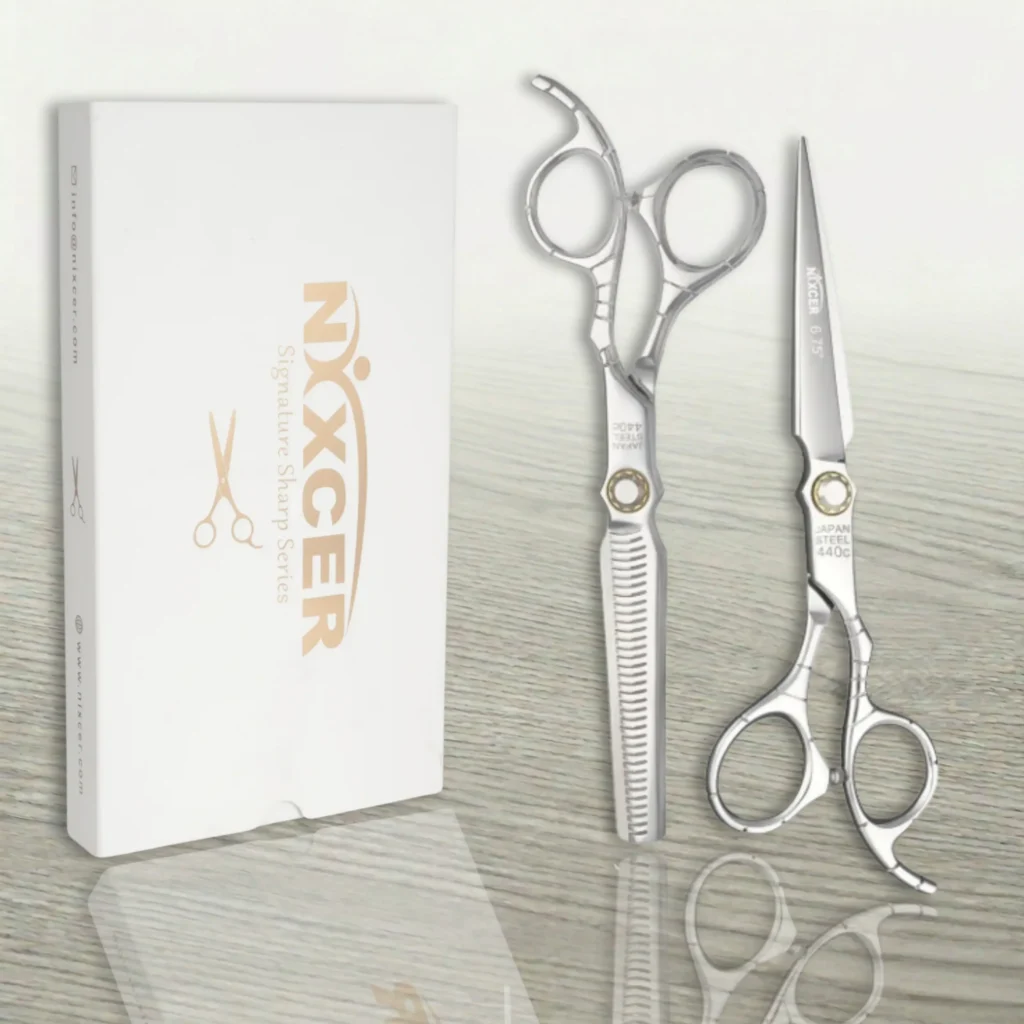
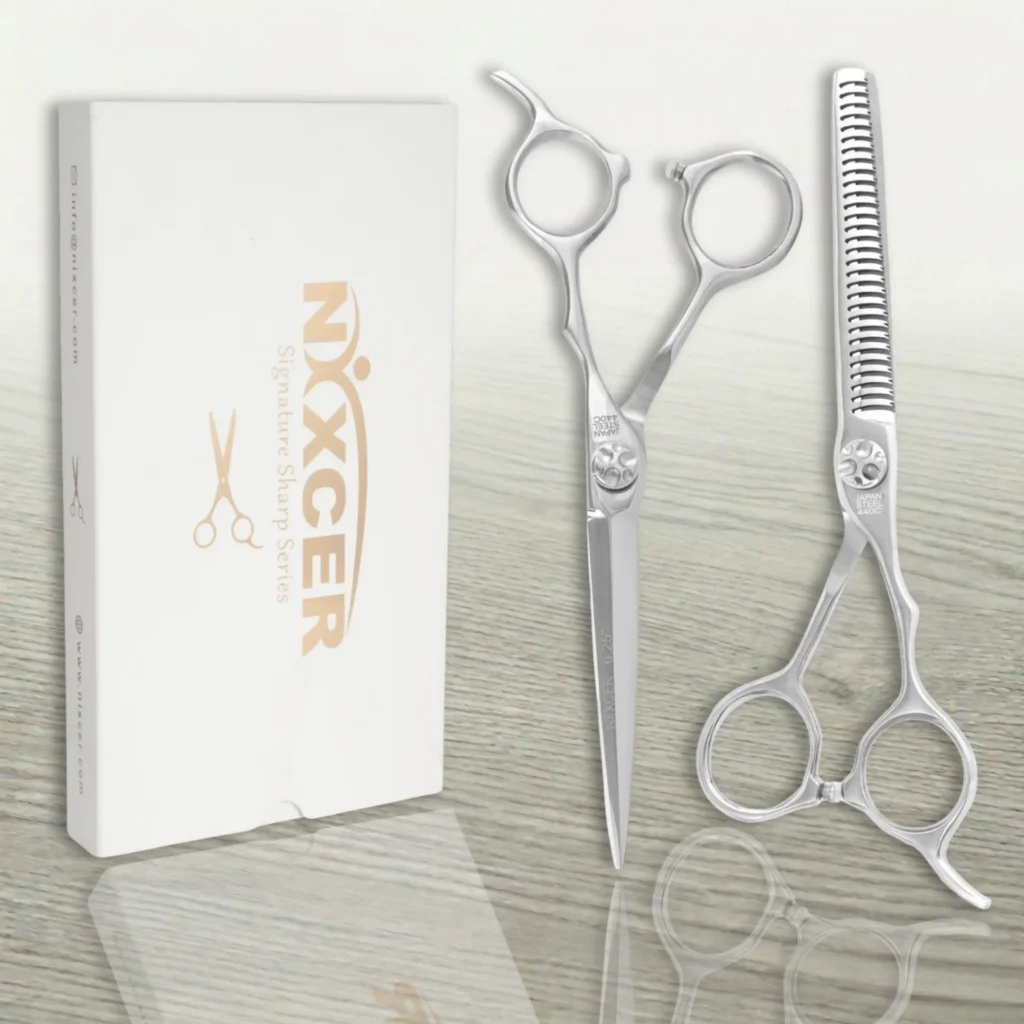
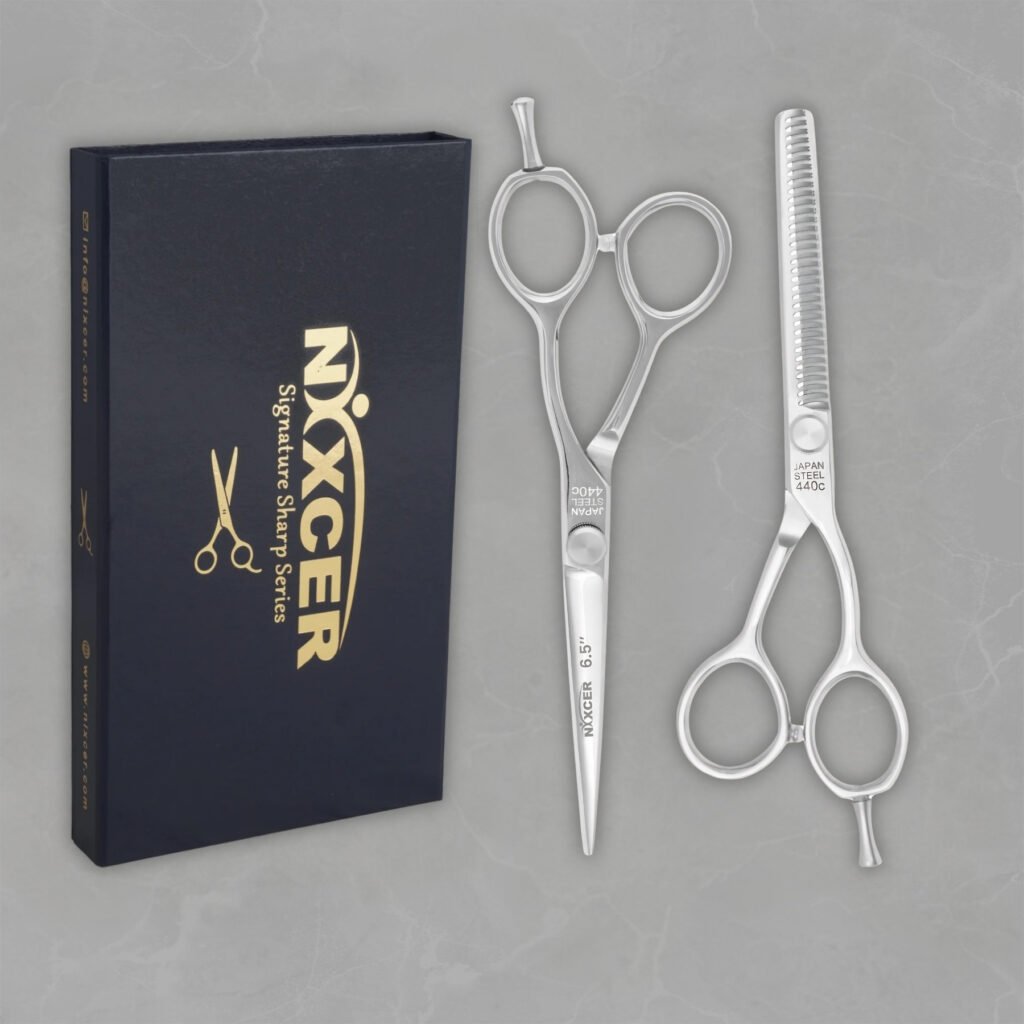
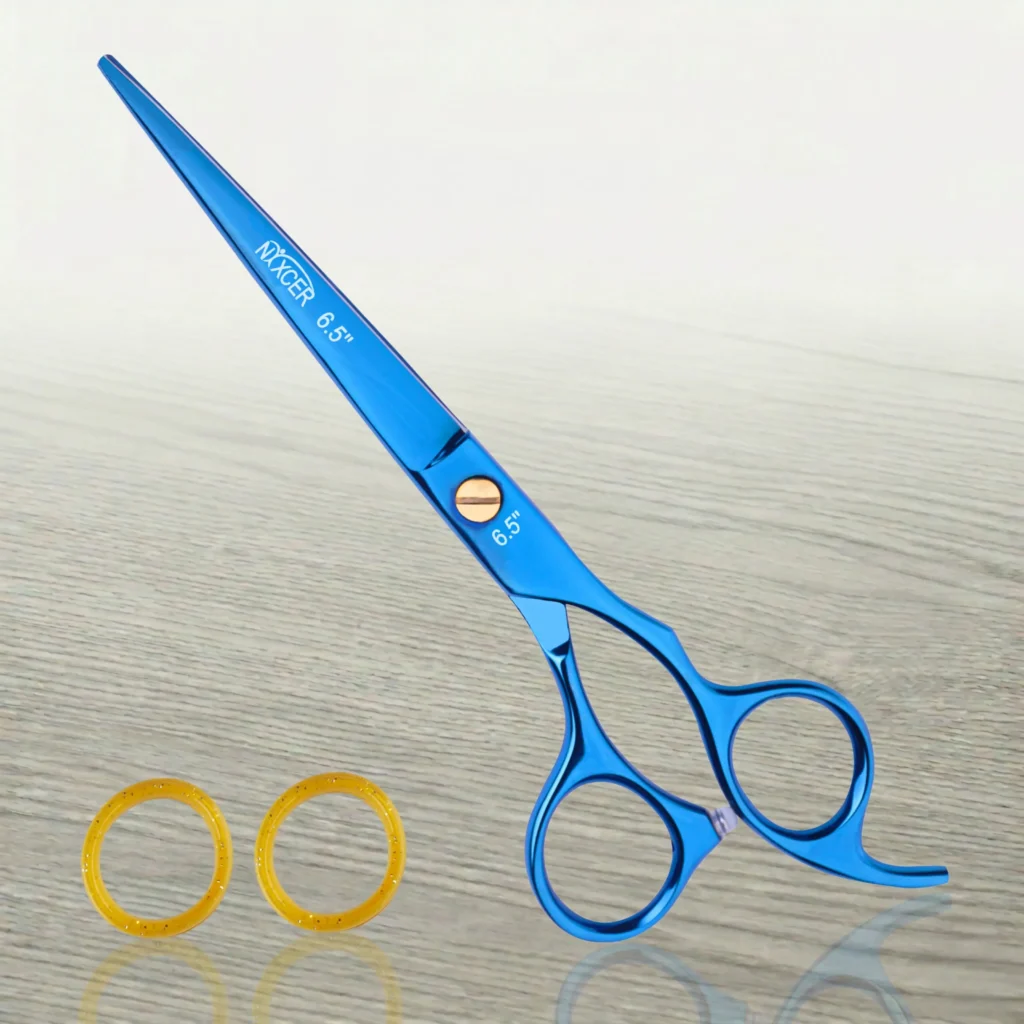
Nixcer offers several blade shapes, lengths, and hardness specifications that can be compared using this guide. These are product options rather than independent quality rankings.
- The Nixcer Arc Hair Cutting Shears are listed with a 6.25 inch length, convex edge, adjustable tension, C440 steel claim, and 60 plus HRC claim.
- The Nixcer Korean Hair Cutting Shears provide a 6.5 inch option for readers comparing a longer professional shear.
- The Nixcer Broad Blade Hair Cutting Scissors provide a broad blade format for comparing stability and cutting power.
- The Nixcer Barber Hair Cutting Scissors are listed with a 6.5 inch length, adjustable screw, J2 420C steel claim, and HRC 53 to 55 claim.
Confirm current specifications, stock, handedness, warranty, maintenance requirements, and return terms on each product page before buying. Browse the full hair cutting scissors collection to compare designs.
Common Quality Mistakes
- Treating Japanese steel as a complete grade or proof of origin.
- Choosing the highest hardness number without considering toughness or sharpening.
- Assuming every convex edge has the same geometry and finish.
- Ignoring alignment because the blades feel sharp near the tip.
- Tightening the pivot to compensate for worn or incorrectly set blades.
- Selecting a handle that looks ergonomic but does not fit the user’s hand.
- Using one shear for techniques that require different blade behavior.
- Letting an unsuitable sharpener change the original edge profile.
- Equating a decorative finish or premium package with cutting quality.
Final Quality Checklist
Before choosing professional hair cutting scissors, confirm that:
- The material and hardness claims are specific and credible.
- The edge geometry matches the intended cutting techniques.
- The blade shape and length suit the typical working section.
- The blades meet consistently from pivot to tip.
- The tension remains stable and the pivot moves smoothly.
- The handle fits the hand and the orientation matches handedness.
- The shear feels balanced without requiring a tight grip.
- Care and sharpening requirements are clear.
- Warranty and service support are available where needed.
- Cutting performance is assessed through a safe controlled test.
Shear quality matters because every part of the tool affects another. The best professional choice is a correctly made and serviceable shear whose cutting action, fit, and blade design remain predictable in the work it was selected to perform.
Frequently Asked Questions
Signs of High Quality Hair Scissors
High quality shears have credible material information, suitable edge geometry, accurate alignment, stable tension, smooth movement, balanced weight, comfortable fit, and a clear service path. A safe cutting test should show consistent performance along the usable blade.
Importance of Steel Quality
Steel affects edge formation, wear resistance, corrosion behavior, toughness, and sharpening. Heat treatment and manufacturing determine how those material properties appear in the finished blade, so the steel name alone is insufficient.
Professional Shears Compared With Regular Scissors
Professional hair shears are designed around hair cutting blade geometry, precise blade contact, controlled pivots, and working handles. General household or stationery scissors are made for different materials and should not be treated as an equivalent salon tool.
Effect of Tension on Cutting Quality
Tension controls blade contact. Too little can let hair fold between the blades, while too much increases operating force and wear. Use the manufacturer’s adjustment method because pivot systems differ.
Expensive Scissors and Quality
Price can reflect steel, manufacturing, finishing, brand, distribution, packaging, or service. It does not prove that the shear is well made or suitable for a specific stylist. Evaluate the complete cutting system and support.
Life of Professional Hair Scissors
There is no universal lifespan. Appropriate steel, careful use, correct maintenance, protected storage, and skilled sharpening can extend service life. Drops, corrosion, excessive metal removal, damaged pivots, and poor alignment can shorten it.
Sharpening Schedule for Quality Shears
Sharpening frequency depends on workload, steel, edge type, hair, care, and technique. Service the tool when cutting performance changes or according to the maker’s guidance. Avoid sharpening on a fixed date if the shear does not need metal removed.