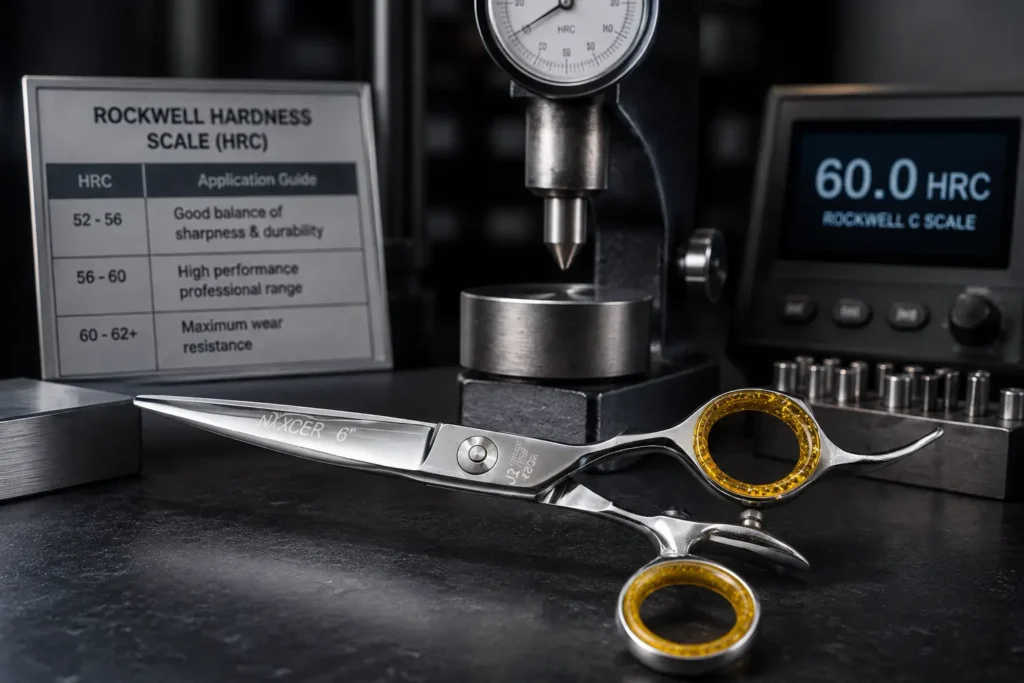
The Rockwell hardness scale for hair cutting scissors helps describe how resistant a steel blade is to permanent indentation. The value most often shown for hardened scissor steel is HRC, which means hardness measured on the Rockwell C scale.
A higher HRC number generally indicates a harder steel surface. Within a well-designed scissor, greater hardness can support wear resistance and longer edge retention. It can also make servicing more demanding and may reduce tolerance for impact when the alloy, heat treatment or blade geometry does not provide enough toughness.
HRC is useful, but it is not a verdict on quality. A well-made 58 HRC scissor with correct blade geometry, alignment and tension can outperform a poorly manufactured scissor advertised at 62 HRC. The most reliable buying decision considers hardness together with steel composition, heat treatment, edge type, balance, ergonomics and professional service support.
Quick answer: Many professional hair scissors are marketed in roughly the mid-50s to low-60s HRC range. Values around 58-60 HRC are commonly positioned as a balance of edge retention and serviceability, while 60-62 HRC models may prioritize longer wear resistance. These are practical shopping ranges, not universal rules. The correct target depends on the steel, heat treatment, blade design and cutting technique.
What Does HRC Mean?
HRC stands for Hardness Rockwell C. The Rockwell method is an indentation test: a calibrated machine presses an indenter into a prepared metal surface under specified forces and measures the permanent change in indentation depth. The C scale uses a diamond indenter and is commonly applied to hardened steels.
If the indenter penetrates less deeply, the material records a higher hardness value on that scale. A label such as 60 HRC therefore means a Rockwell C hardness number of 60. It does not mean the steel is “60 percent hard,” and it is not an overall product score out of 100.
Rockwell testing is standardized through methods such as ASTM E18 and ISO 6508. Test accuracy depends on the machine, indenter, surface preparation, part thickness, geometry, calibration and test location. This matters because a hardness measurement taken at one location may not represent every physical characteristic of the finished scissor.
How the Rockwell C Test Works in Plain Language
The testing process can be summarized in four stages:
- A prepared test surface is placed securely in the hardness tester.
- A preliminary force seats the diamond indenter and establishes a reference position.
- A larger specified force is applied and then removed according to the test procedure.
- The machine converts the remaining indentation-depth difference into the HRC value.
The test measures resistance to indentation, not cutting sharpness. It is possible for two scissors to carry the same HRC rating yet feel completely different because their edges, blade profiles, polishing, hollow grind, alignment and tension are different.
HRC Is Not the Same as Sharpness
Hardness and sharpness are related only indirectly.
Hardness describes resistance to permanent indentation under a standardized test. Sharpness describes the condition and geometry of the cutting edge. A softer blade can be sharpened to a fine edge, and a very hard blade can still be dull, chipped or poorly ground.
The cutting feel also depends on how the two blades work together. The edge angle, convex or beveled profile, ride line, blade set, pivot condition and tension determine whether the scissors close smoothly and cut hair cleanly from heel to tip.
For this reason, HRC should be used to narrow choices, not to replace a cutting-performance evaluation.
Hardness vs. Toughness, Wear and Corrosion Resistance
Several material properties are often mixed together in product descriptions. They are not interchangeable.
Hardness
Resistance to localized permanent indentation. This is what HRC reports.
Toughness
The ability to absorb energy and resist cracking or chipping. A steel can be hard without being exceptionally tough. Alloy design and heat treatment strongly influence the balance.
Wear Resistance
Resistance to material loss from friction and abrasion. Hardness can contribute to wear resistance, but carbide type, carbide distribution and blade finish also matter.
Corrosion Resistance
Resistance to rust, staining and chemical attack. Chromium content, alloy chemistry, surface finish and maintenance affect corrosion behavior. HRC alone does not tell you how corrosion-resistant the steel is.
Edge Retention
The ability of the cutting edge to maintain useful performance. Hardness and wear resistance can support edge retention, but edge geometry, cutting technique, hair condition, tension and maintenance affect how long the edge actually lasts.
Practical HRC Ranges for Hair Cutting Scissors
| Approximate HRC range | Typical buying interpretation | Main tradeoff to evaluate |
| Below 55 HRC | Softer or entry-level blade range in some product lines | May be more forgiving to service but can lose edge performance sooner under heavy use |
| 55-58 HRC | General-purpose range used by many durable salon and barber scissors | Balance edge retention with blade geometry, finish and sharpening quality |
| 58-60 HRC | Common professional target for a blend of sharpness support, wear resistance and serviceability | Confirm the actual steel, heat treatment and edge profile |
| 60-62 HRC | Higher-hardness professional or premium range | Can hold a refined edge well but requires careful handling and skilled sharpening |
| Above 62 HRC | Specialized high-hardness models and selected premium steels | Not automatically better; toughness, thin-edge stability and service capability become especially important |
These bands are a practical comparison aid, not a technical specification for every alloy. A manufacturer may select different target hardness values for cutting blades, thinning teeth, blade geometry or intended use. Treat a model-specific range as more useful than a generic claim about “Japanese steel” or “premium steel.”
Why Harder Is Not Always Better
It is tempting to compare scissors by choosing the highest HRC number. That approach ignores the engineering tradeoffs.
A very hard edge may resist wear, but a thin blade can become more sensitive to impact, twisting or drops if toughness is insufficient. A lower-hardness blade may need sharpening sooner, yet it can be robust and easier for an experienced technician to service. The best result comes from matching hardness to the alloy, blade thickness, edge angle and intended technique.
The number also says nothing about comfort. A 62 HRC scissor with poor balance or an unsuitable handle will not become ergonomic because the steel is hard. Nor will hardness correct loose tension, misalignment or an inaccurate tip.
Steel Grade Does Not Guarantee a Fixed HRC
Steel names describe a composition or grade, not the final mechanical condition of every blade. Heat treatment changes that condition.
During manufacturing, steel is hardened and tempered to reach a target combination of hardness, toughness, wear resistance and dimensional stability. Two manufacturers can use nominally similar steel but choose different heat-treatment cycles, target hardness ranges, blade geometry and finishing processes.
That is why “440C,” “VG-10,” “cobalt alloy” or “Japanese steel” should not be treated as a complete specification. Ask for the actual model’s hardness range and blade construction. Our guide to hair cutting scissor steel types explains the material labels in more detail.
HRC and Blade Geometry Must Work Together
The edge and blade profile determine how the material is used.
Convex Edge
A convex edge can be ground to a fine, smooth cutting profile. A suitably hardened and correctly heat-treated steel helps support that refined edge. Convex scissors require a sharpener who can preserve the original geometry.
Semi-Convex Edge
Semi-convex construction combines some of the smooth cutting characteristics of a convex profile with additional support near the edge. Its performance still depends on the complete blade design.
Beveled or Micro-Serrated Edge
A beveled edge generally has a more defined secondary angle and can provide a firm cutting feel. Micro-serration adds grip. These profiles may use a different hardness and geometry strategy than a highly polished convex edge.
Compare the tool by technique, not HRC alone. See the guide to different hair cutting scissor blade types before selecting an edge.
Which HRC Range Suits Different Users?
Students and Developing Stylists
A durable, serviceable scissor in the mid-50s HRC range can be practical while hand control and maintenance habits are developing. The fit, alignment and edge condition matter more than chasing a premium number.
Busy Salon Professionals
Many daily-use professional models fall around 58-60 HRC. This range is often selected to balance useful edge life with routine professional servicing. Technique, section size and maintenance will determine the real sharpening interval.
Precision, Dry and Slide-Cutting Specialists
Some stylists prefer a refined convex blade around 60 HRC or above for smooth cutting and edge retention. The model must still provide sufficient toughness and correct geometry, and it should be serviced by a technician experienced with high-hardness convex shears.
Barbers and Scissor-Over-Comb Work
Barbers may prioritize blade stability, length, balance and repeated closing comfort. A moderate or higher HRC can both work when the complete scissor is designed for over-comb use. The hardest option is not automatically the fastest or most comfortable.
For a task-based selection framework, review how to choose scissors for precision cutting.
How to Read an HRC Product Claim
When a product page lists hardness, check the wording carefully.
- Exact number: “60 HRC” is a stated target or result, but it does not show manufacturing tolerance by itself.
- Range: “58-60 HRC” communicates a production band and is often more realistic than a single marketing number.
- Plus sign: “60+ HRC” indicates at least approximately 60 in the seller’s claim, but it is less precise than a documented range.
- Steel name only: The steel grade does not reveal the final hardness without heat-treatment information.
- No test source: Treat an unsupported number as a manufacturer or seller specification, not an independent laboratory certificate.
Also confirm that HRC is the scale being quoted. Rockwell uses several scales for different material and test conditions; an HRB value is not directly interchangeable with HRC.
Current Nixcer HRC Examples
Nixcer’s current product pages show why HRC should be read model by model.
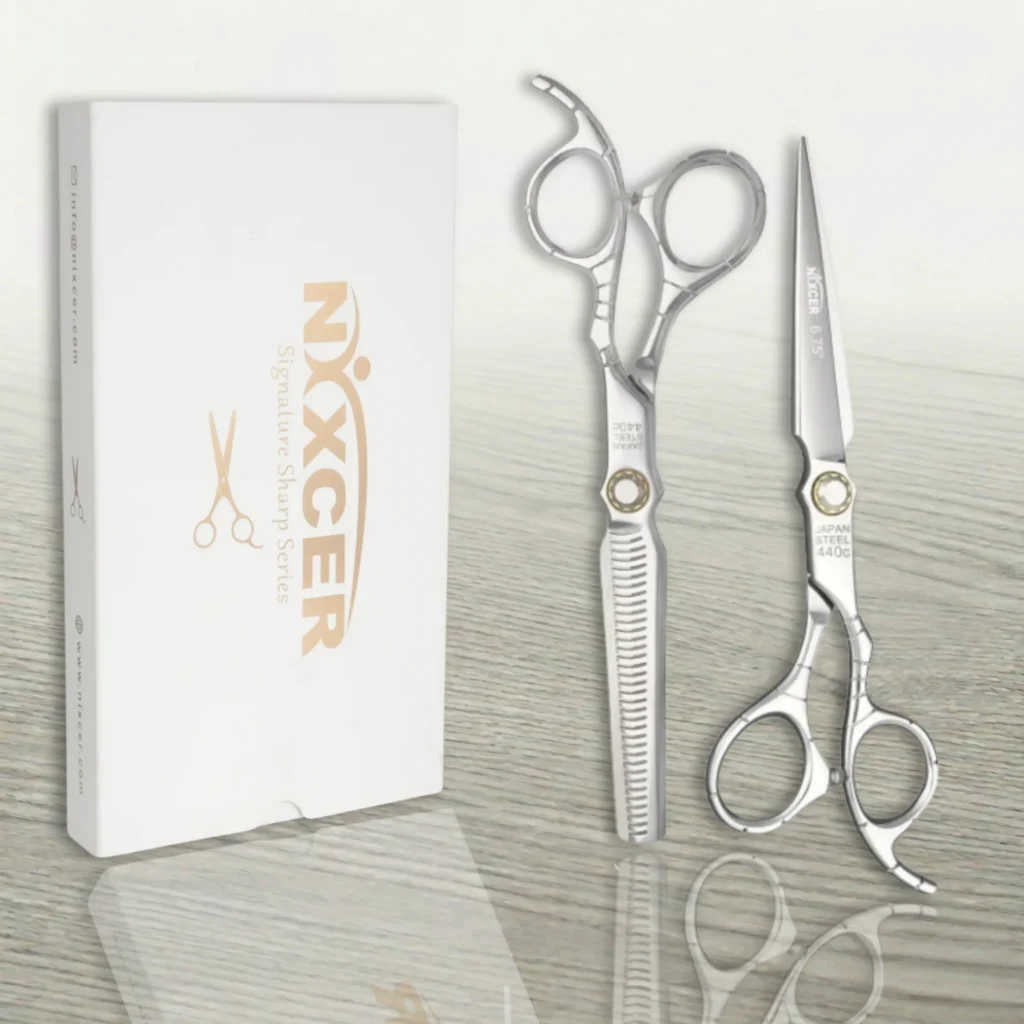
The Signature Sharp Series ARC Hair Cutting Shears list C440 Japanese steel, a convex edge and Rockwell hardness of 60+ HRC. This positions the model as a higher-hardness professional shear, but its edge geometry, 6.25-inch size, tension system and ergonomic design remain equally relevant.
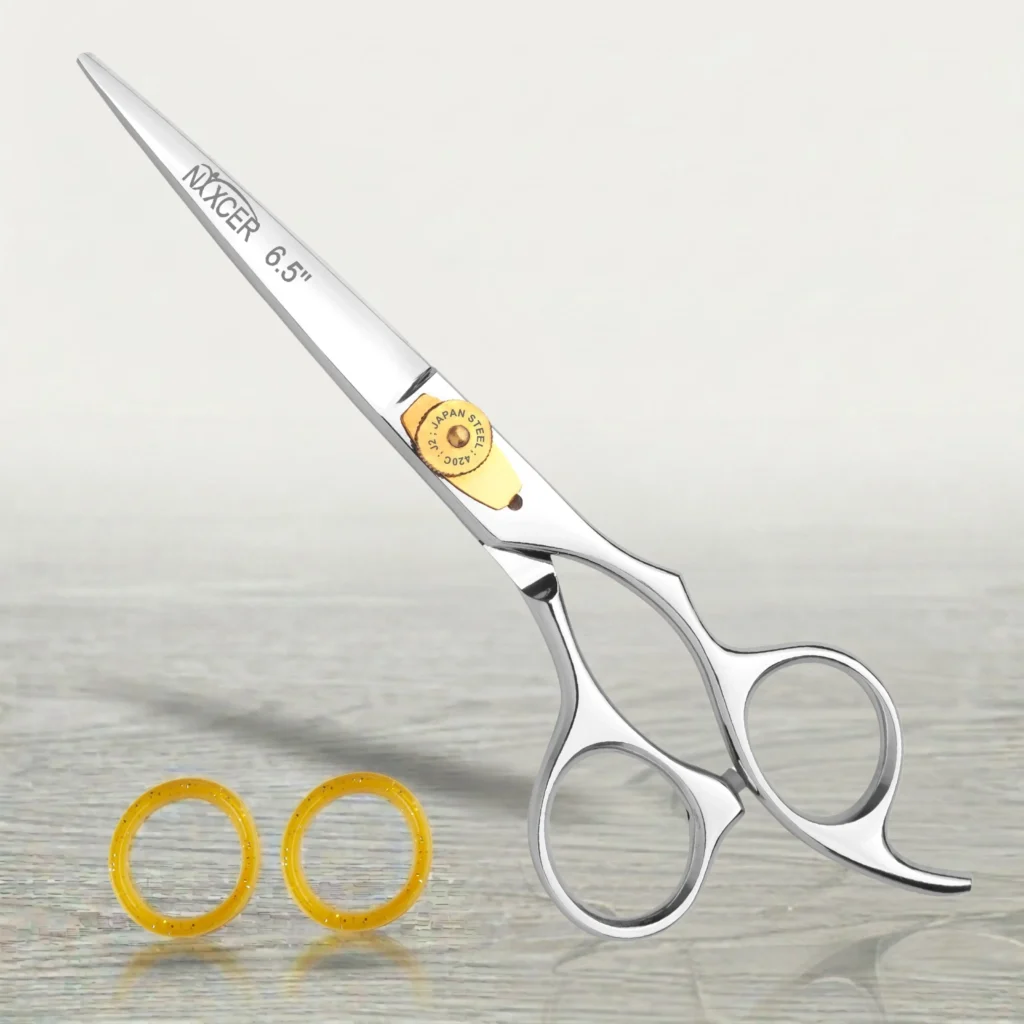
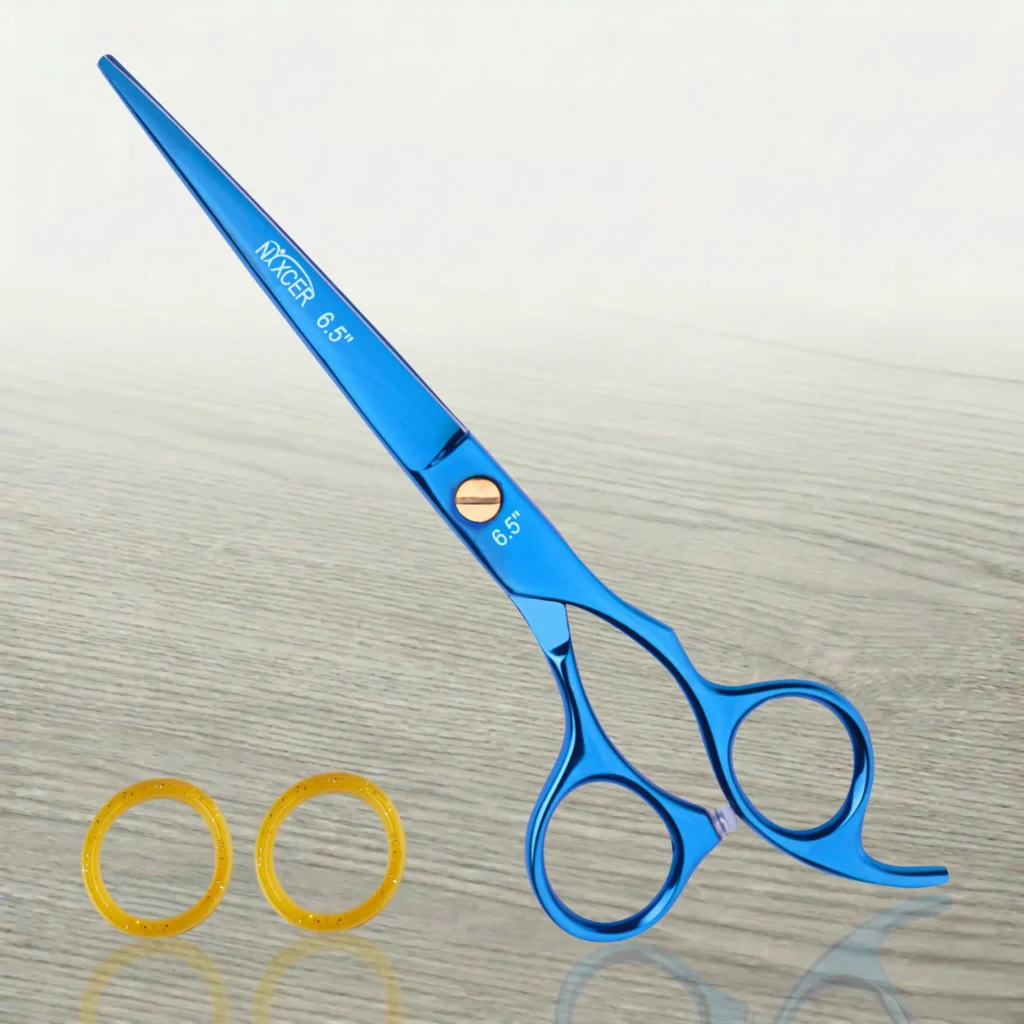
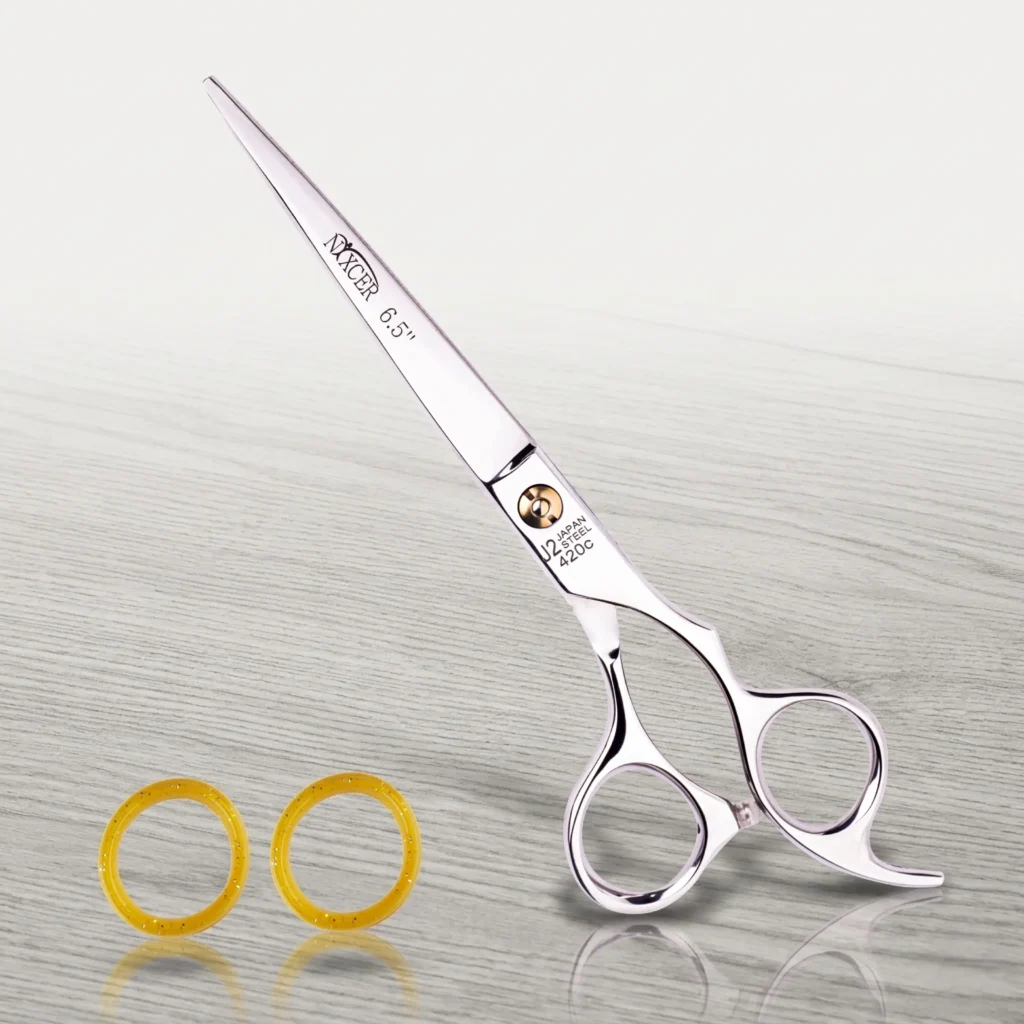
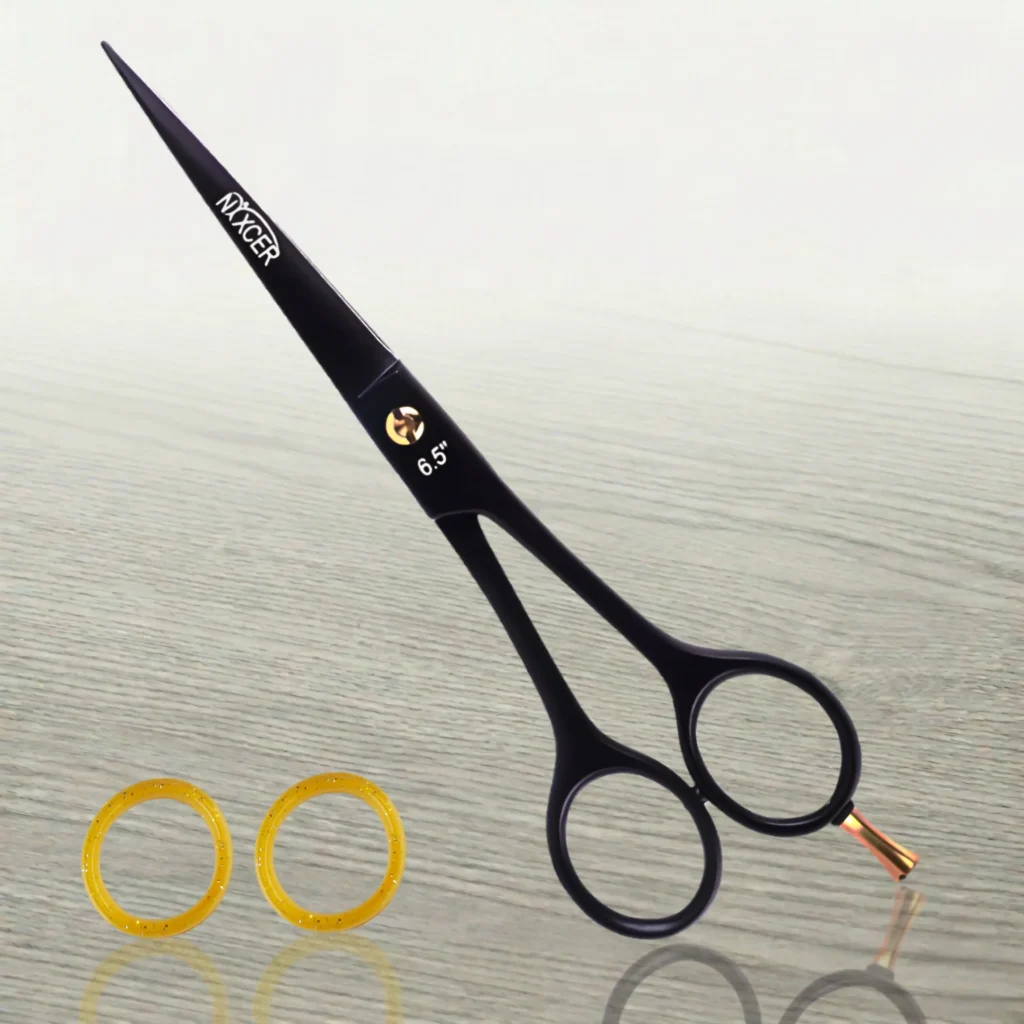
The Barber Hair Cutting Scissors Japanese Steel list J2 420C steel and HRC 53-55. Their 6.5-inch length, offset grip and adjustable screw make the product a different tool, not simply a lower number in the same category.
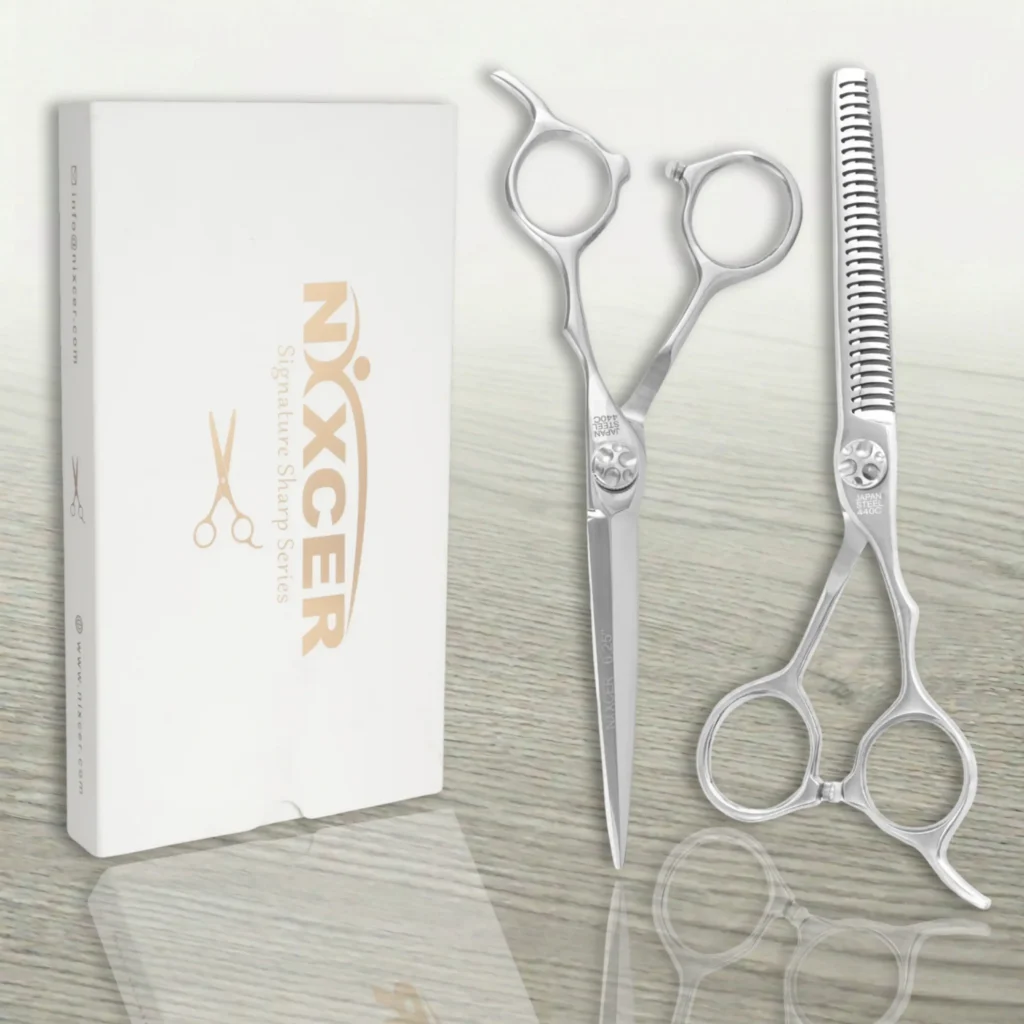
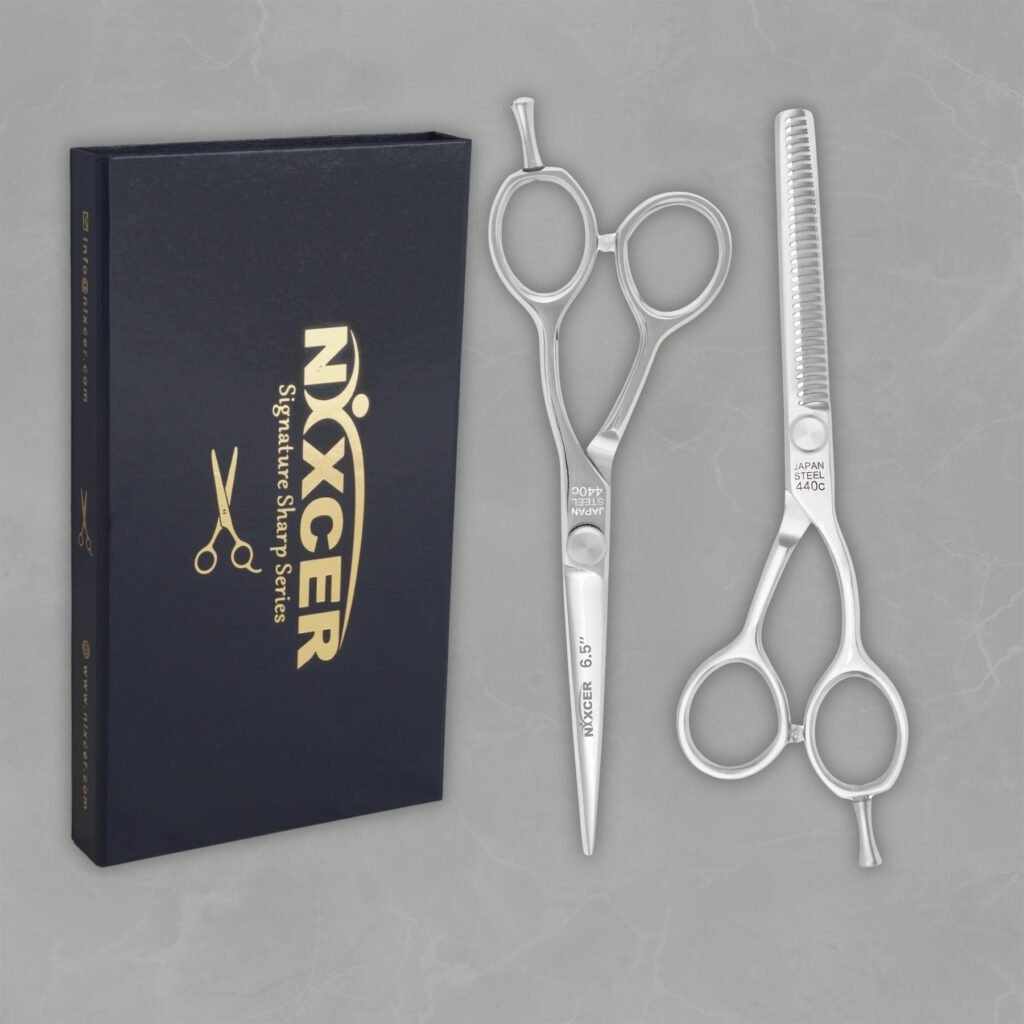
Nixcer’s main site also currently presents 440C models with an HRC 58-60 specification. Because collections can contain different steels and heat treatments, always check the individual product page when you shop Nixcer hair cutting scissors.
HRC and Sharpening
Higher-hardness and wear-resistant steels can require more time, appropriate abrasives and greater control during sharpening. More importantly, every edge type requires the correct method. A sharpener must preserve the convex curve, bevel angle, inside hollow, ride line, tip relationship and blade set.
Poor sharpening can remove excessive metal, alter the edge angle, round the tips or overheat the blade. Heat generated during aggressive grinding can damage the carefully created temper near the edge. For premium or high-HRC scissors, use a technician who regularly services professional hair shears rather than a general knife or household-scissor service.
Do not sharpen according to a fixed HRC schedule. Book service when the scissors push hair, fold hair, snag at the tips, feel rough or require extra hand pressure. A hair cutting scissor maintenance kit supports cleaning, oiling, tension checks and safe storage between services.
Maintenance Matters at Every Hardness
Hard steel is not maintenance-free. Hair, product residue, disinfectant moisture and friction at the pivot can reduce performance regardless of HRC.
Use these habits:
- Wipe the blades after each service.
- Remove trapped hair from the pivot area.
- Keep the scissors dry before storage.
- Apply the recommended scissor oil to the pivot and ride area.
- Check tension after cleaning and oiling.
- Store the scissors closed in a protective case.
- Use professional hair shears only on hair, not paper, tags or plastic.
- Stop cutting if the blades push, fold, snag or become noisy.
Correct tension is especially important because tight blades create unnecessary friction while loose blades may fold hair. Follow the hair scissor tension-test guide and learn why regular oiling supports smooth blade movement.
HRC Buying Checklist
Before buying scissors based on a Rockwell claim, ask:
- Is the value stated as HRC, not another Rockwell scale?
- Is it a specific number, a realistic range or an imprecise “plus” claim?
- What steel grade and heat-treatment specification does the model use?
- Is the blade convex, semi-convex, beveled or micro-serrated?
- Does the hardness suit the blade thickness and intended cutting technique?
- Can a qualified local technician sharpen that edge and steel?
- Does the manufacturer offer service, parts or warranty support?
- Is the handle comfortable and available in true right- or left-handed construction?
- Are the tension, alignment and tip performance checked before delivery?
- Does the complete scissor suit your technique better than a model chosen only for a higher HRC number?
Common Rockwell Hardness Myths
Myth: The Highest HRC Is Always the Best
Reality: Higher hardness can support edge retention, but toughness, geometry, heat treatment, balance and serviceability determine whether the scissor performs well.
Myth: HRC Measures Sharpness
Reality: HRC measures indentation hardness. Sharpness is a condition of the cutting edge and its geometry.
Myth: Every Scissor Made from the Same Steel Has the Same HRC
Reality: Heat treatment and tempering can produce different hardness targets from similar steel grades.
Myth: Hard Scissors Never Need Sharpening
Reality: Every cutting edge wears or can be damaged. Hardness may influence wear rate, but use and maintenance determine service needs.
Myth: A One-Point Difference Guarantees Better Performance
Reality: Small differences may fall within production or measurement variation, and they do not outweigh major differences in edge geometry, alignment, finish or fit.
Final Thoughts
The Rockwell hardness scale for hair cutting scissors is most useful when treated as one verified specification in a larger system. HRC describes resistance to indentation. It can help indicate how a properly made blade may balance wear resistance, edge retention and serviceability, but it does not measure sharpness, toughness, corrosion resistance or ergonomics by itself.
Compare the model’s actual hardness range, steel, heat treatment, blade geometry, tension system and intended technique. Then consider who will service the scissors and how carefully they will be maintained. The best professional shear is not the one with the biggest HRC number; it is the one whose material, design and workmanship suit the work behind the chair.
Frequently Asked Questions
What does HRC mean on hair cutting scissors?
HRC means hardness measured on the Rockwell C scale. It reports the steel’s resistance to permanent indentation under a standardized test procedure.
What is the best HRC for professional hair cutting scissors?
There is no universal best value. Many professional scissors are marketed around 58-60 HRC, while some premium models reach 60-62 HRC or higher. The right choice depends on steel, heat treatment, edge geometry, toughness and service support.
Is 60 HRC good for hair scissors?
Yes, 60 HRC can be a strong professional specification when the steel is properly heat-treated and the blade is well designed. It should still be evaluated with alignment, edge type, tension, balance and ergonomics.
Is 62 HRC better than 58 HRC?
Not automatically. A 62 HRC blade may offer greater wear resistance, but a well-made 58 HRC scissor can be tougher, easier to service or better suited to a specific technique. Manufacturing quality matters more than the number alone.
Does higher HRC mean sharper scissors?
No. Higher HRC means greater indentation hardness on the C scale. Sharpness comes from edge geometry, grinding, polishing and current edge condition.
Do harder hair scissors stay sharp longer?
They often resist wear better, which can support longer edge retention. Actual service life also depends on steel microstructure, blade design, tension, cutting technique, workload and maintenance.
Are high-HRC scissors more brittle?
Higher hardness can reduce impact tolerance in some steels and geometries, but brittleness is not determined by HRC alone. Alloy design, heat treatment, toughness and blade thickness all matter.
Can I compare HRC and HRB numbers directly?
No. HRC and HRB use different Rockwell test scales, indenters and forces. Any conversion is approximate and material-dependent; compare values on the same scale whenever possible.
Does Japanese steel always have a higher HRC?
No. “Japanese steel” is a broad origin or marketing description, not a fixed hardness. The specific alloy and heat treatment determine the final HRC.
How often should high-HRC scissors be sharpened?
Use performance signs rather than a fixed calendar. Arrange professional sharpening when the scissors push, fold or snag hair, lose tip performance or require extra hand pressure.