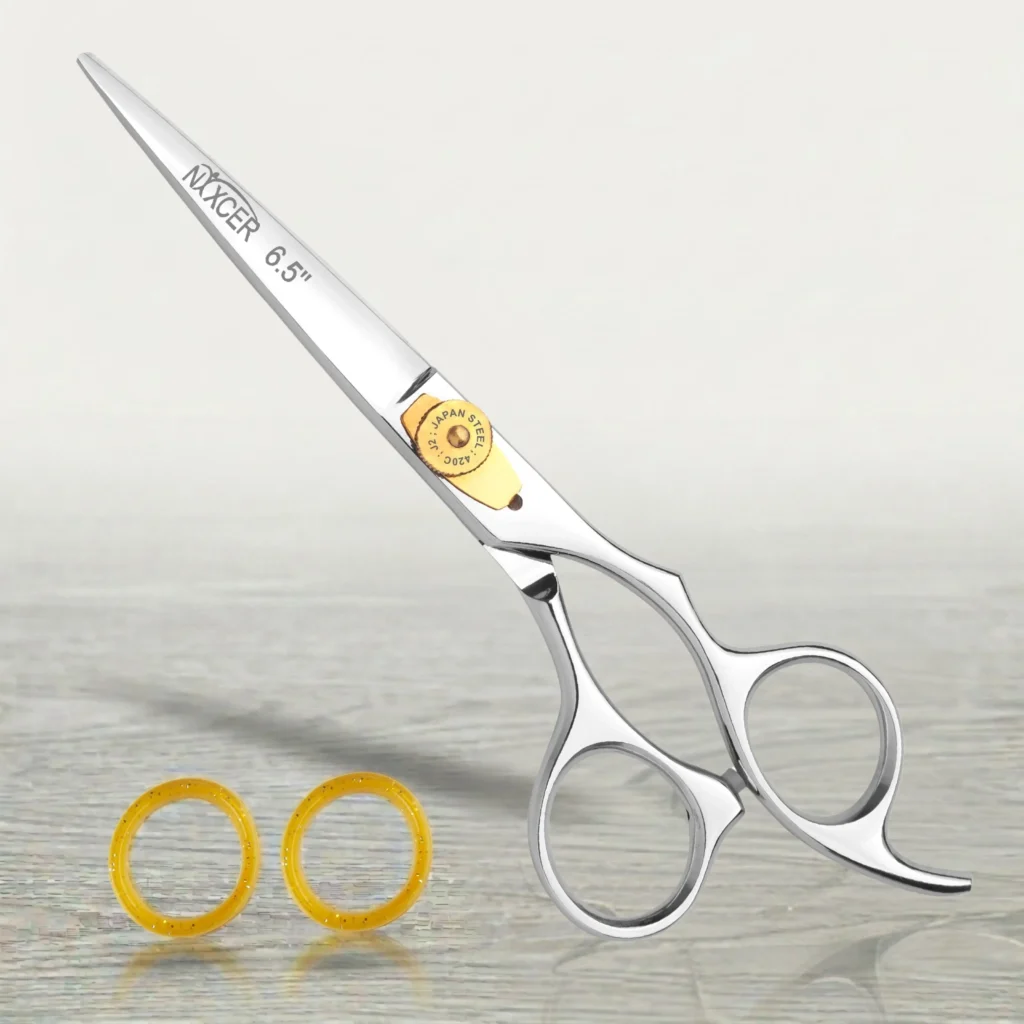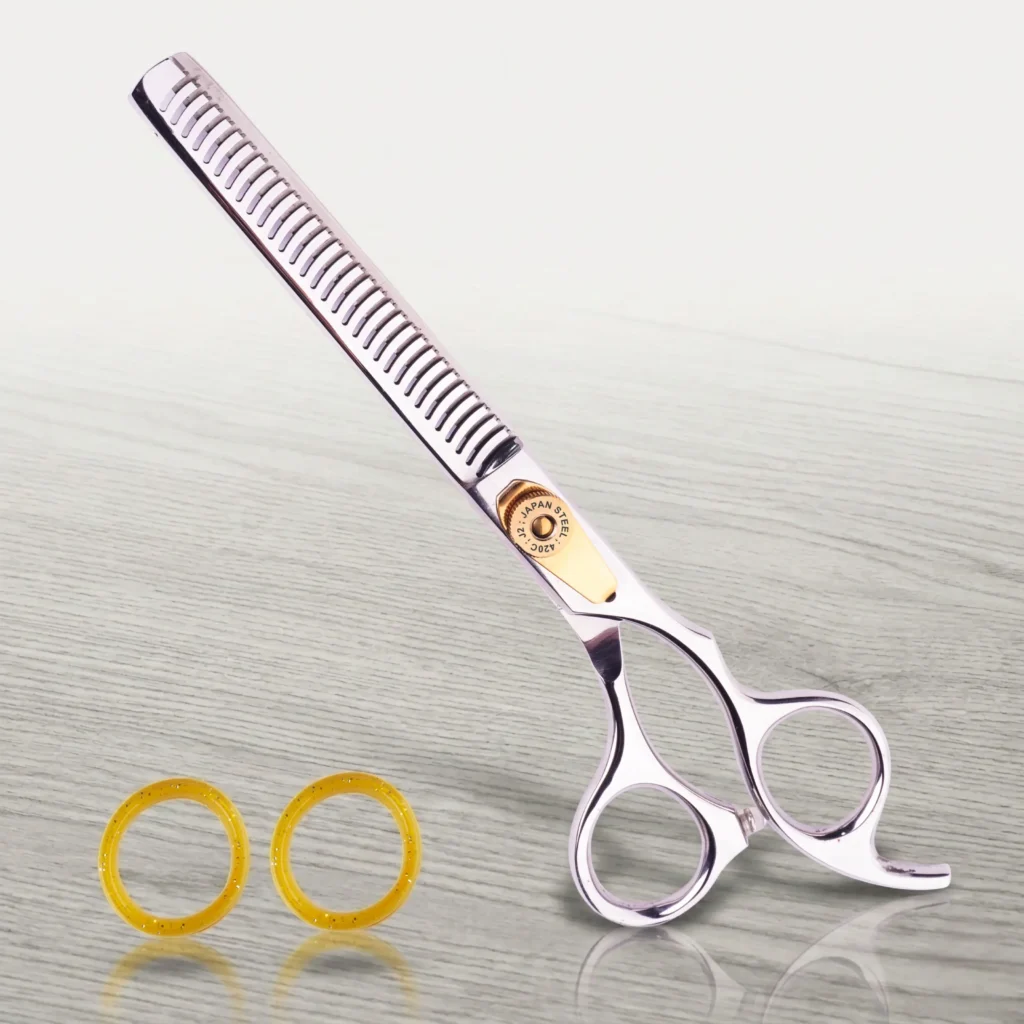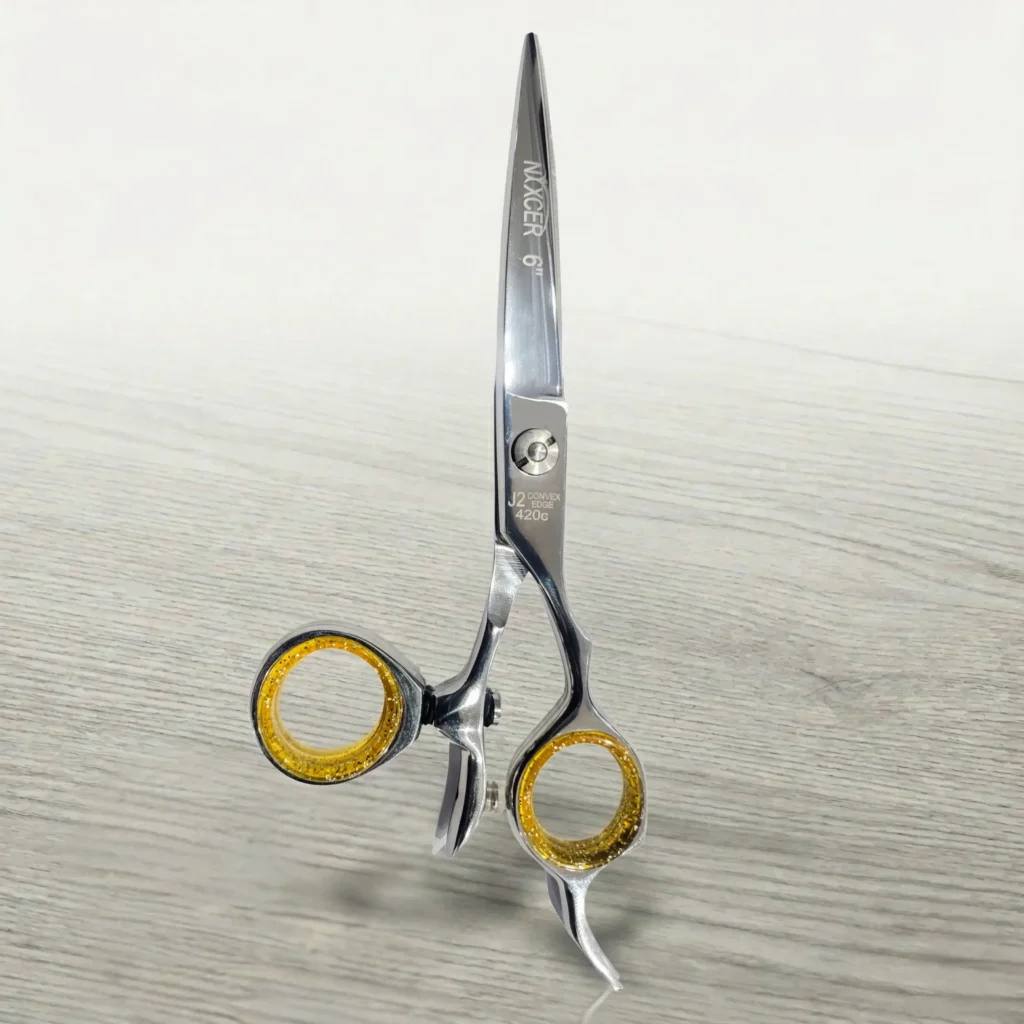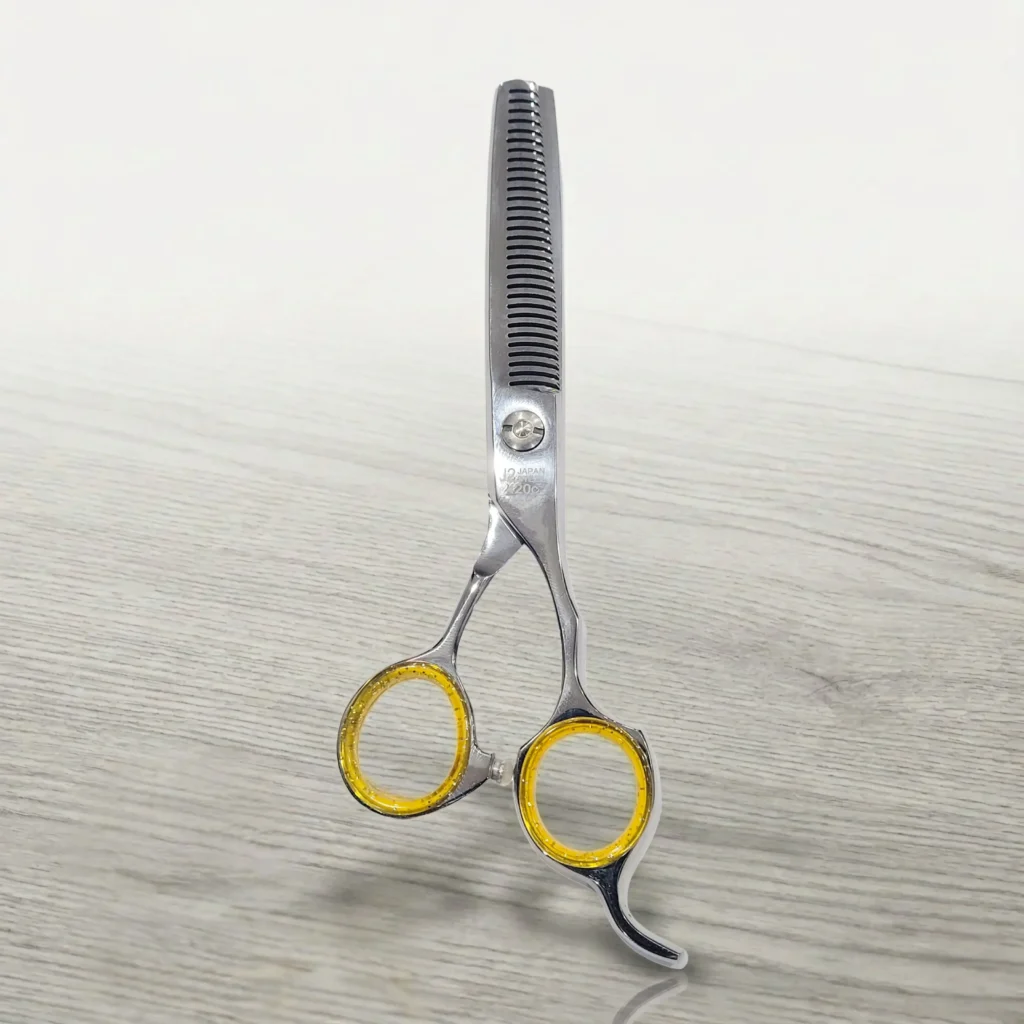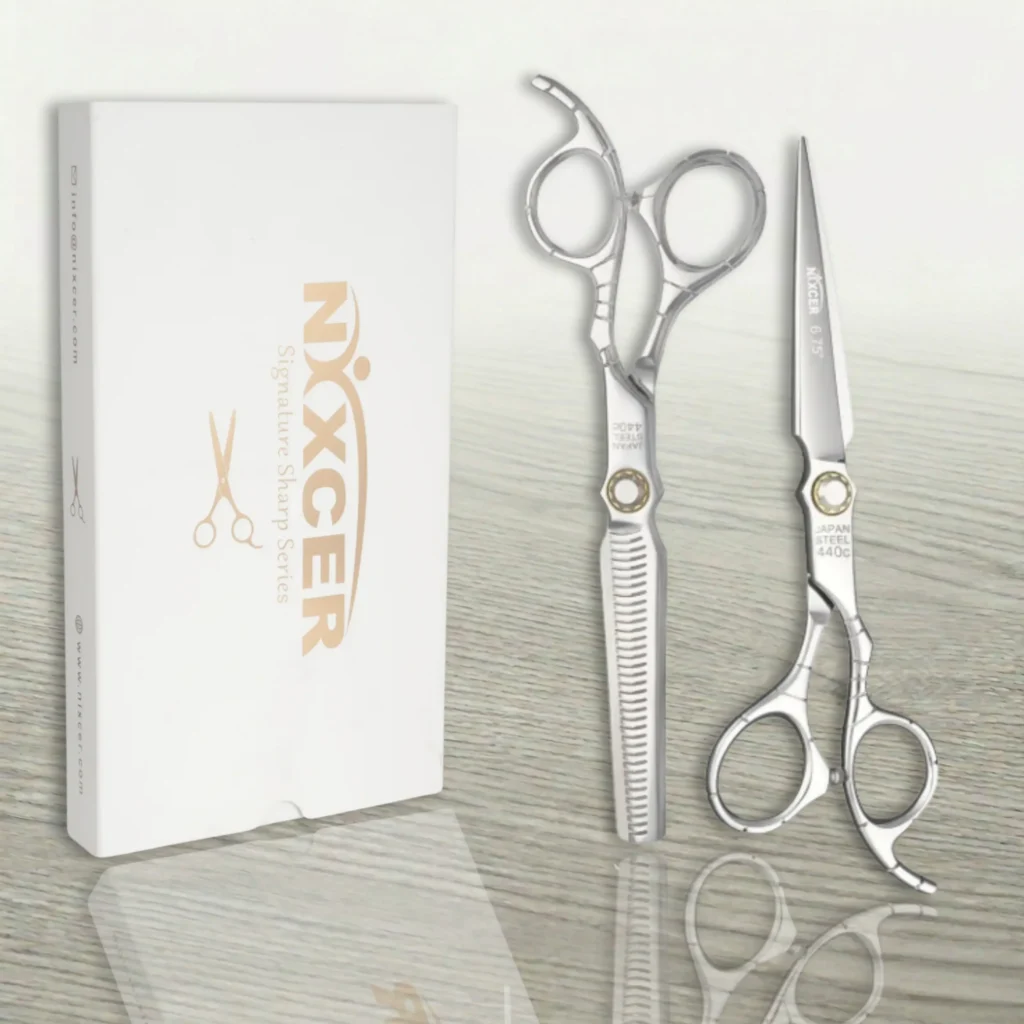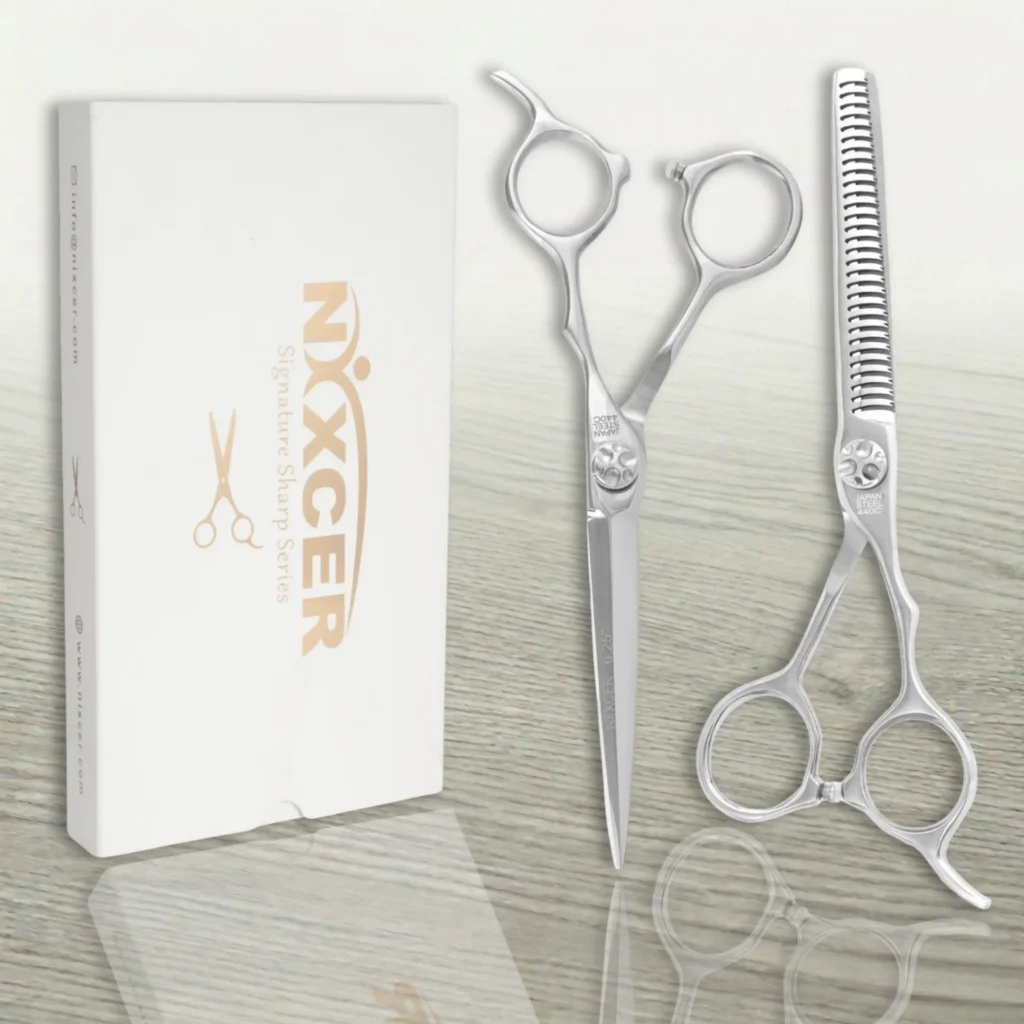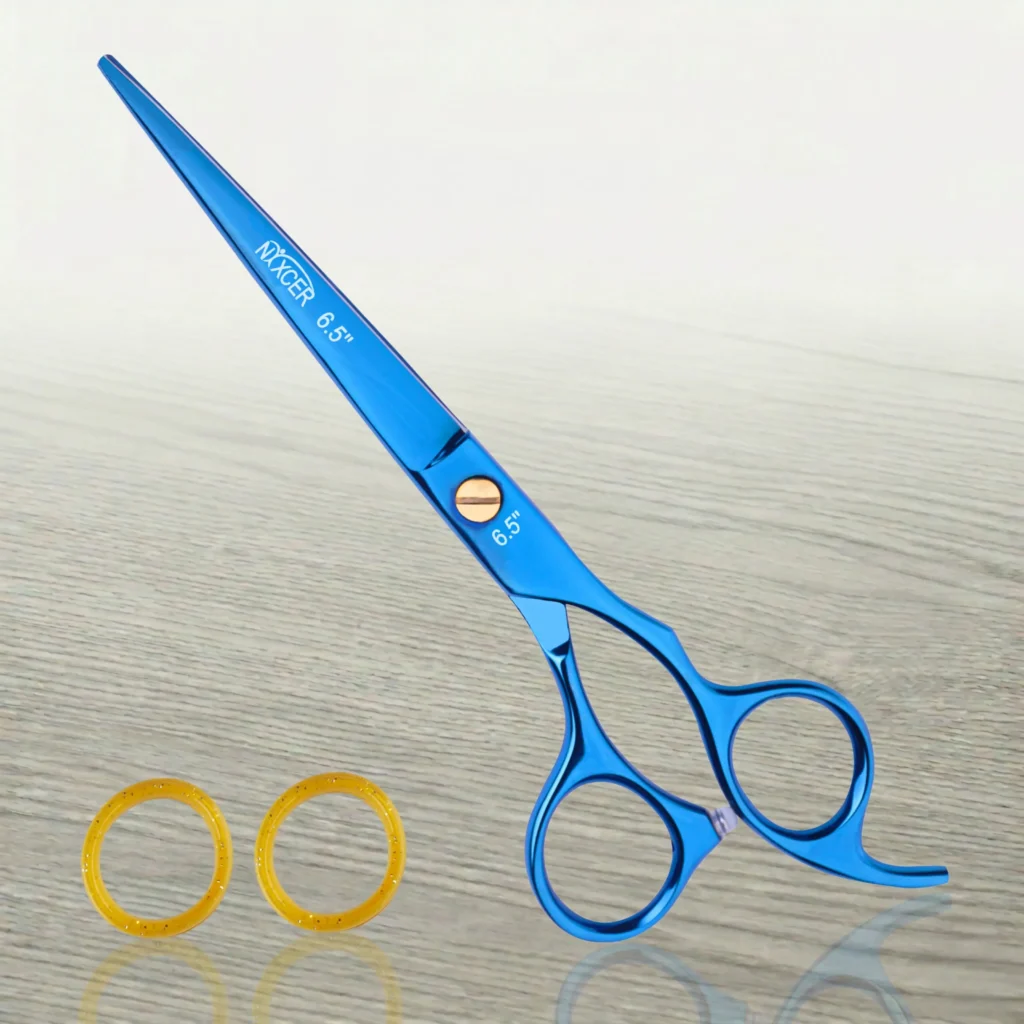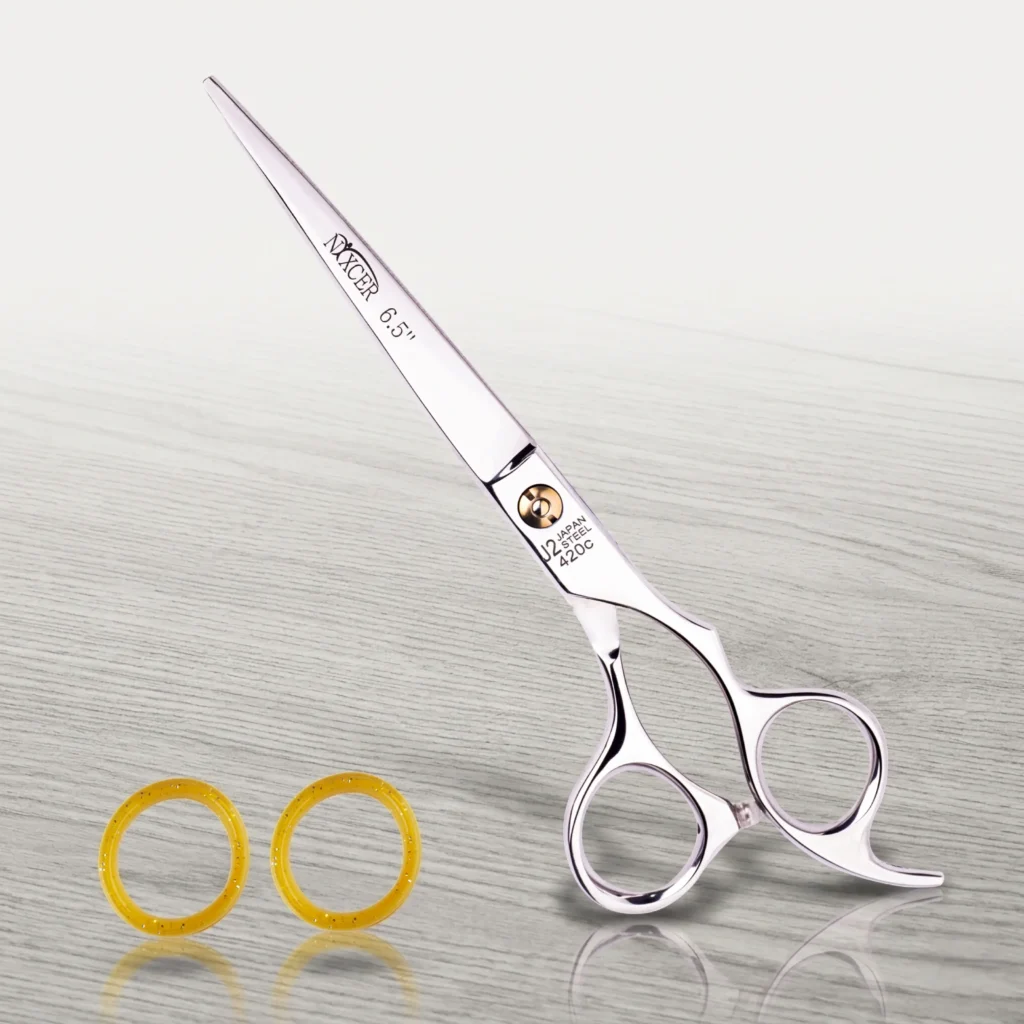
To perform a tension test on hair cutting scissors, first check the care instructions for your exact shear. Prepare the tool as directed, hold it securely by a handle, and release the moving handle from the specified opening position. Compare its movement with the manufacturer’s expected result. Adjust only when permitted, then repeat the test and confirm cutting performance on approved hair.
A gravity test, also called a drop test, checks how the shear moves under its own weight. It does not prove that the cutting edges are sharp or the blades correctly aligned. The useful result is the one specified for your model, followed by smooth operation and a clean cut.
Why Scissor Tension Matters
The tension assembly sits at the pivot where the two blade halves meet. Its setting affects their contact and the resistance you feel during opening and closing. If you are unfamiliar with these parts, start with our guide to hair cutting scissor anatomy.
A loose setting can allow hair to fold between blades that would otherwise cut. An overly tight setting can make the tool difficult to operate. Neither symptom establishes the cause by itself. Residue, an edge problem, or damaged geometry can also affect performance, so test before changing the screw.
Is a 45 Degree Stop Always Correct
No. Manufacturer instructions differ in both test position and expected movement. Hanzo’s tension guide describes a gravity test with an approximate halfway stop. Hikari’s maintenance instructions use a different holding position and expect its blades to remain mostly open; halfway closure is too loose under that method. MIZUTANI’s manual uses a 90-degree opening and identifies full closure or no closure as conditions requiring attention.
These methods should not be mixed. A result judged under one brand’s setup may mean something different under another. For Nixcer scissors, ask for the instructions for the exact model if the supplied guidance is unclear. Do not assign a universal pass angle based on blade size, price, or edge label.
Before You Begin
Work at a clear station over a padded surface. Hold only the handles and keep the cutting edges away from your fingers, face, and anyone nearby. In a drop test, you release one handle while securely supporting the other; you never drop the complete shear.
Have the correct adjustment key or driver available, along with the maker’s recommended care materials. Check for visible damage and confirm that the tension assembly is meant for user adjustment. Some new shears have special break-in instructions. MIZUTANI, for example, cautions against loosening certain newly supplied blades before their initial wearing-in period.
If the tool was dropped and now catches or cuts differently, arrange an inspection instead of using screw adjustment to compensate. A passing gravity test does not rule out impact damage.
Step 1 Prepare the Shear as Directed
Remove loose hair and visible residue using the approved cleaning method. Lubricate where and when the care instructions specify, and wipe away excess so the handles remain secure. Do not flood an unfamiliar bearing assembly with oil or assume every pivot requires the same routine.
Preparation affects the comparison. Testing once with a contaminated pivot and again after cleaning changes more than the screw setting. Follow the same preparation and holding method each time. Our cleaning and disinfection guide and scissor oiling guide explain related care tasks. Cleaning, lubrication, and disinfection serve different purposes.
Step 2 Position the Handles Correctly
Use the orientation shown in your model’s instructions. A common gravity method holds the finger-ring side upright, points the tips upward, and opens the thumb-ring side to about 90 degrees. This describes a common setup, not an instruction to override the manufacturer.
Support the held handle without squeezing the two halves sideways together. Keep your grip and starting position consistent. If the written directions leave you uncertain about which handle to release, ask the seller for a demonstration rather than handling the blades to recreate a photograph.
Step 3 Release and Observe
Let go of the moving handle without flicking or guiding it. Watch the movement and stopping position. Notice whether the stroke is smooth, whether it catches at a particular point, and whether repeating the same setup produces a similar result.
Record the observation before adjusting. A short note such as “closes fully from the instructed position” is more useful than “feels wrong.” If movement is rough or inconsistent, pause and check the preparation and grip. Persistent catching needs inspection, not repeated experimentation with the screw.
Step 4 Interpret the Result for Your Model
Use this table as a screening aid. The manufacturer’s instructions determine whether a specific stopping point passes.
| Observation | Possible meaning | Next action |
| Smooth movement to the specified stop | Consistent with the model’s test | Check normal operation and cutting |
| More closure than the maker allows | Tension may be too loose | Make a permitted small correction and retest |
| Less movement than the maker allows | Tension may be too tight | Check preparation before a permitted correction |
| Catching or uneven movement | Residue or a mechanical problem may be present | Stop if approved routine care does not resolve it |
| Passes but still folds hair | Gravity testing has not identified the cutting fault | Arrange further assessment rather than keep tightening |
Do not classify all mostly open shears as too tight. That may be the expected result under a different manufacturer’s method. Likewise, a halfway stop cannot certify every shear as correctly adjusted.
Step 5 Make a Small Permitted Adjustment
Identify the actual adjustment point and use the specified tool. A decorative pivot cover is not necessarily the adjuster. JOEWELL documents several screw designs, including a dry bearing system, which illustrates why pivot construction matters. A tool that fits one shear may be unsuitable for another.
On many conventional systems, clockwise rotation increases tension and counterclockwise rotation decreases it. Confirm the direction and viewing side in your instructions. Make the smallest prescribed correction, remove the tool, and retest. MIZUTANI specifies one notch at a time for the adjustment described in its manual; do not transfer that increment to every screw design.
Avoid full turns, removing the screw, or dismantling the pivot as part of a routine check. Stop if the driver does not seat properly, the screw resists unexpectedly, or the setting will not hold. Repeated loosening can indicate a service issue.
Step 6 Confirm Cutting Performance
Once the model’s tension check passes, assess ordinary opening and closing with a light grip. Then use a small section of clean human hair approved by the manufacturer for a controlled cutting check. Keep this separate from client work while investigating a problem.
Do not use paper, fabric, plastic, or a synthetic wig as a universal test material. Hikari specifically restricts its shears to human hair and warns that even treated mannequin hair can be unsuitable. Check the material rather than relying on a wig label.
Observe where a cut fails and report that location to the service provider. Consult our hair cutting scissor sharpness guide for related assessment. Tightening a screw does not sharpen an edge.
How Often Should You Check Tension
Follow your manufacturer’s schedule and check whenever the tool’s feel or performance changes. Hikari recommends daily testing, particularly early in use while its pivot washer settles. A brief check before a working session is a useful routine when compatible with your shear’s care instructions.
Checking is different from adjusting. Leave a satisfactory setting alone. Keep a simple record if the tension changes repeatedly: note the model, test result, correction, and whether it stayed stable. That history can help a technician assess the mechanism.
When to Seek Professional Service
Remove the shear from client work if it has damaged tips, persistent catching, unusual blade contact, or a tension setting that repeatedly slips. Provide the exact model and describe any impact or chemical exposure. Do not bend the blades, grind the inner faces, or force the halves together to make them cut.
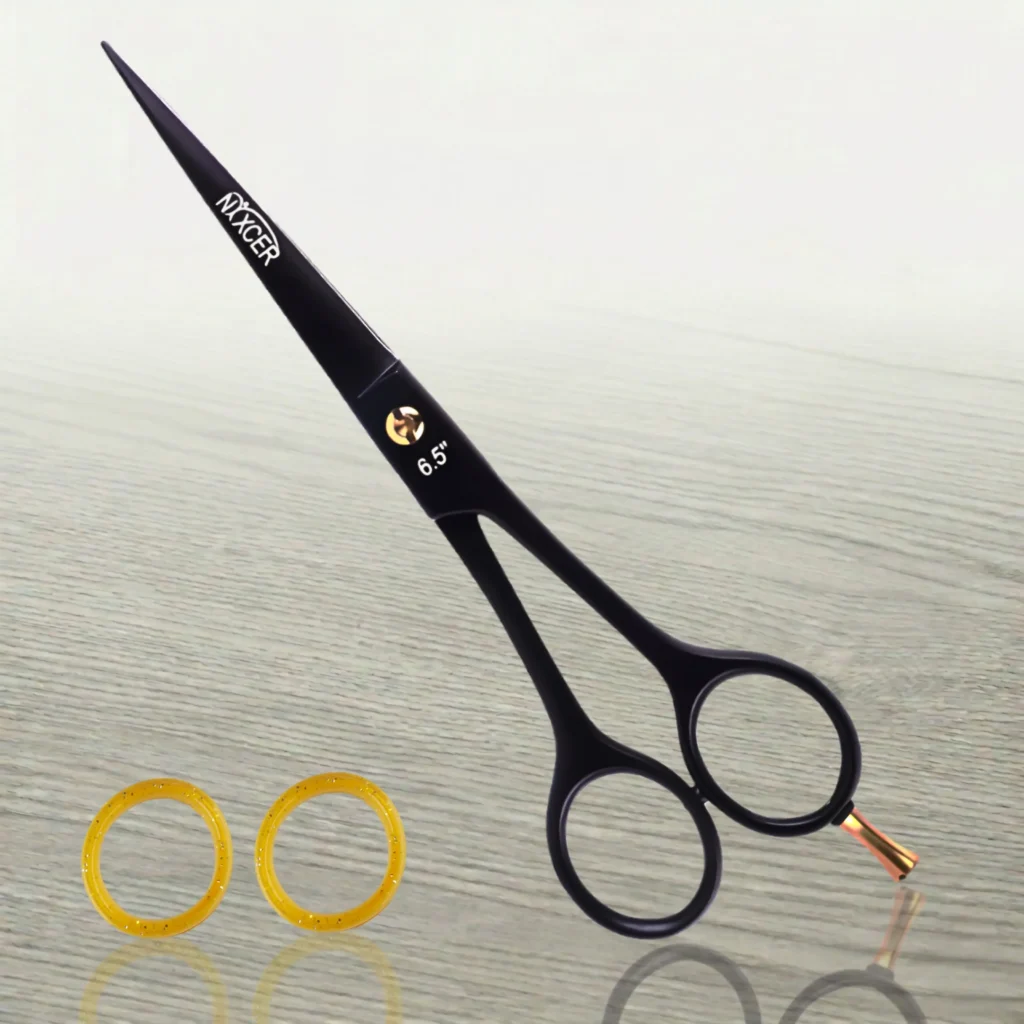
Use the Nixcer hair cutting scissors collection to identify your model. The Nixcer Broad Blade scissors listing describes key screw adjustment. Confirm the compatible key and test method with Nixcer; the listing alone does not establish a calibrated drop angle.
Frequently Asked Questions
How Tight Should Hair Cutting Scissors Be
They should meet the maker’s test result and operate smoothly within their intended setting. There is no universal stopping angle or resistance measurement for every professional shear.
What Is the Difference Between a Tension Test and a Sharpness Test
A tension test examines movement at the pivot under a specified setup. A cutting assessment examines how the tool cuts approved hair. Passing the first does not guarantee passing the second.
Which Direction Tightens the Screw
Clockwise commonly tightens and counterclockwise commonly loosens when viewed from the adjustment side. Confirm the exact system before turning it, and use its supplied tool.
Should I Adjust Tension for Every Hair Type
Do not repeatedly change a correct setting simply because the next client has a different hair texture. Follow model guidance, use suitable sections, and investigate a performance change before altering the pivot.
Can a Tension Test Fix Scissors That Fold Hair
The test may identify a loose setting, but it does not fix the tool by itself. If a permitted correction restores performance, tension was a contributing factor. If folding continues, further assessment is needed.
Should I Use a Coin Instead of a Tension Key
Only if the manufacturer expressly permits it for that screw. Otherwise obtain the compatible key or driver. Do not force an improvised tool into a recessed adjustment point.
Can I Test Thinning Scissors the Same Way
Use the instructions for the thinning model. The toothed blade changes cutting behavior, and a test intended for a different shear cannot establish the correct setting.