Hair cutting scissors did not appear as a finished salon tool in a single moment. They developed over thousands of years as metalworkers improved cutting mechanisms, steelmaking advanced, barbering became a profession, and hairstylists demanded greater precision and comfort.
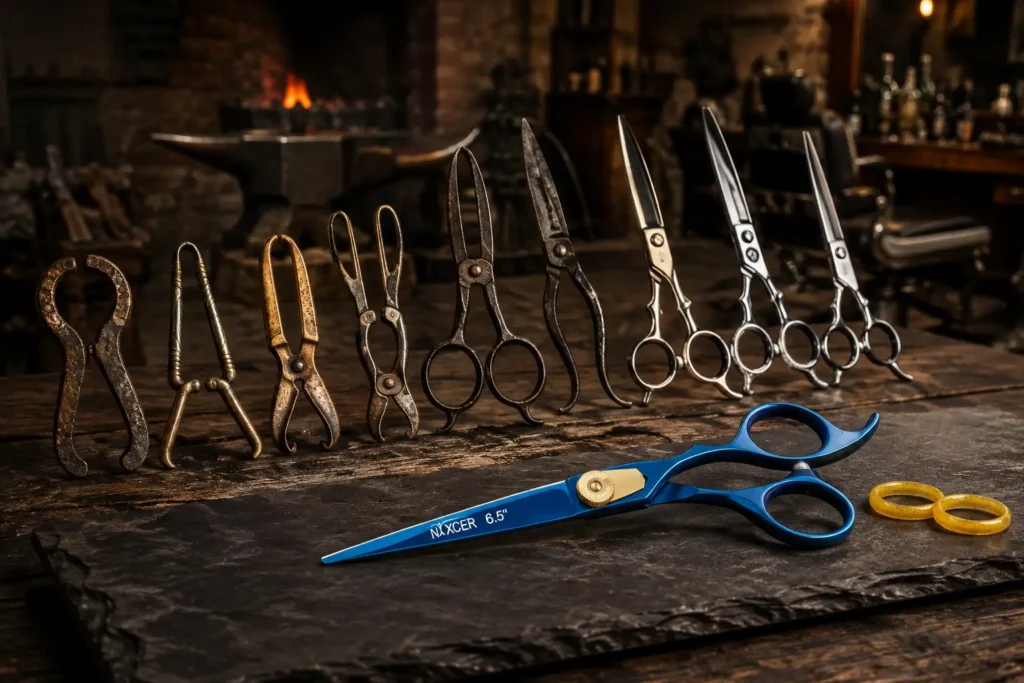
The earliest scissor-like tools were spring shears: two blades joined by a flexible strip of metal. Pivoted scissors, with crossed blades connected around a central joint, later created the mechanical foundation of the modern design. Industrial steel production made scissors more consistent and affordable, while twentieth-century metallurgy and ergonomics transformed them into specialized professional instruments.
A Short Timeline of Hair Cutting Scissors
| Period | Important development | Why it mattered |
| Prehistory and early civilization | Hair was cut with sharp stone, shell, metal blades, and razors | Grooming existed before scissors |
| Bronze and Iron Age | Spring shears appeared in several ancient cultures | Two blades could be operated with one hand |
| Greek and Roman era | Barbers used razors, knives, shears, and pivoted cutting tools | Professional grooming became a visible social service |
| Middle Age | Iron and steel shears and scissors were made for specialized tasks | Better forging supported sharper, more durable tools |
| 18th-century Sheffiel | Cast steel and organized scissor manufacturing expanded | More consistent, polished scissors could be produced at scale |
| 19th centur | Industrial grinding, standardized parts, and commercial barbering grew | Hair-cutting tools became more specialized and widely available |
| 20th centur | Stainless steels, precision manufacturing, and ergonomic designs developed | Salon shears became sharper, more durable, and more comfortable |
| Toda | Convex edges, adjustable tension, offset handles, and texturizing designs are common | Stylists can match the tool to the technique and hair type |
Before Scissors: How Did People Cut Hair?
Humans groomed and shortened hair long before metal scissors existed. Early communities could use sharpened stone flakes, shells, knives, or razors to cut or scrape hair. Archaeological evidence shows that ancient cultures produced very sharp stone and metal blades, although it is rarely possible to prove that a particular surviving blade was used specifically on hair.
This distinction matters. The history of hair cutting is older than the history of scissors, and the history of scissors is older than the modern category of dedicated hairdressing shears. Early cutting tools were usually multipurpose objects rather than salon instruments.
Ancient Spring Shears: The First Scissor-Like Design
Many popular histories date early bronze spring shears to roughly the second millennium BCE and associate them with ancient Egypt or the broader Near East. The basic form used two blades connected by a curved or flexible strip. Squeezing the blades together made the cut; releasing pressure allowed the metal spring to reopen them.
Spring shears were simple, durable, and effective, but they did not provide the same finger control as modern pivoted scissors. Surviving ancient examples are often difficult to assign to one specific job. They may have cut textiles, animal fibers, hair, or other materials.
Iron Age evidence confirms that U-shaped shears were used across parts of Europe before the Roman Empire. The British Museum records Iron Age shears from La Tène cultural contexts, demonstrating that the spring-shear form was established well before modern manufacturing.
Greek and Roman Barbering
Barbering held an important place in Greek and Roman society. Barbers cut and dressed hair, trimmed beards, and sometimes performed other personal-care tasks. Roman barbers were known as tonsores, and barber shops could also function as social meeting places.
The barber’s toolkit might include combs, razors, knives, tweezers, curling tools, and shears or scissors. It would therefore be inaccurate to imagine one standardized pair of “Roman hair scissors.” Different tools served different grooming tasks, and designs varied by date and region.
Pivoted cutting instruments were known during the Roman period. Unlike spring shears, pivoted scissors used crossed blades connected at a central joint. This mechanism offered better leverage and directional control and eventually became the basis of most modern scissors.
The archaeological record also shows that older forms continued alongside newer ones. The Metropolitan Museum of Art holds an ornate pair of second-century Roman-period shears, showing that spring-style tools remained relevant even after pivoted designs had appeared.
Scissors in the Middle Ages
During the Middle Ages, both spring shears and pivoted scissors were used for practical work. Blacksmiths and specialist metalworkers forged cutting tools from iron and steel, adapting size and shape to textiles, household work, agriculture, medicine, and grooming.
Surviving objects show that pivoted scissors had become recognizable in medieval Europe. A pair of Western European iron scissors in The Met, dated to the fifteenth or sixteenth century, closely resembles the crossed-blade mechanism familiar today.
Barbers occupied a broader role than the modern haircut specialist. In parts of Europe, barber-surgeons shaved and cut hair while also carrying out procedures such as bloodletting, tooth extraction, and wound care. Their tools reflected this overlap between grooming, craft, and medicine.
Religious customs also gave hair cutting symbolic importance. The tonsure, in which part of the head was shaved or clipped, marked membership or devotion in several Christian traditions. Scissors and shears were therefore not only everyday tools; they could take part in ceremonies and expressions of social identity.
Renaissance Craftsmanship and Increasing Specialization
By the late medieval and Renaissance periods, European metalworking centers were producing a wider range of scissors for distinct uses. Blade length, point shape, handle size, and ornamentation could vary according to the intended craft.
Scissors were still expensive handmade objects compared with later industrial products. Producing a good pair required forging, filing, grinding, heat treatment, fitting the pivot, and aligning the blades so their cutting edges met correctly. These same fundamentals remain important in high-quality scissors today.
Although surviving examples can be identified as household, embroidery, tailoring, or surgical scissors, it is harder to determine exactly when “hair cutting scissors” became a consistently separate commercial category. The specialization happened gradually as professional barbering and hairdressing created demand for lighter, sharper, and more controllable tools.
Sheffield Steel and the Rise of Modern Scissor Manufacturing
Sheffield, England, became one of the world’s major centers for cutlery and toolmaking. Its access to skilled labor, grinding traditions, and advances in steel production made the city central to the history of scissors.
Crucible cast steel, developed in the Sheffield area during the eighteenth century, offered more uniform material than many earlier steels. Robert Hinchliffe is traditionally credited with producing cast-steel scissors in Sheffield around 1761. The significance of this development is not that scissors suddenly appeared, but that hardened, polished steel scissors could be manufactured with greater consistency.
The history of Sheffield scissor making also involved highly specialized workers. Forgers shaped the blanks, grinders formed the blades, and finishers fitted and polished the completed tool. Heritage Crafts’ account of traditional scissor making notes how crucible steel and later stainless steel strengthened Sheffield’s reputation for high-quality scissors.
For barbers and hairdressers, improved steel meant edges could be made sharper, slimmer, and more durable. Better manufacturing also improved blade alignment and pivot accuracy—two qualities that directly affect whether scissors cut cleanly or push hair away.
The 19th Century: Industrialization and Professional Barbering
The nineteenth century brought mechanized grinding, standardized components, expanding factories, and broader distribution networks. Scissors became more affordable and more consistent, while manufacturers could produce different patterns for household, tailoring, surgical, and grooming work.
At the same time, barbering and women’s hairdressing developed as increasingly distinct services. Urban growth created larger customer bases, and changing hairstyles demanded greater technical control. Barbers needed dependable scissors for cutting short shapes and blending, while hairdressers required tools capable of refined lines, layering, and detailed work.
The modern silhouette of professional hair shears began to emerge: two narrow blades, finger rings, a central pivot, and a finger rest or tang on some designs. Even when the materials and finishing were less advanced than today’s, the tool was becoming recognizable as a dedicated extension of the cutter’s hand.
The 20th Century: Stainless Steel and Salon Specialization
Twentieth-century metallurgy changed professional scissors dramatically. Stainless steel, developed in the early 1900s, improved corrosion resistance and simplified maintenance. Alloy design and heat treatment enabled manufacturers to balance hardness, toughness, and sharpenability.
Precision machining also improved consistency. Manufacturers could control blade curvature, edge angle, pivot fit, and surface finish more reliably. As salon education became more formalized, scissors were designed for specific cutting techniques rather than treated as one universal tool.
Important twentieth-century developments included:
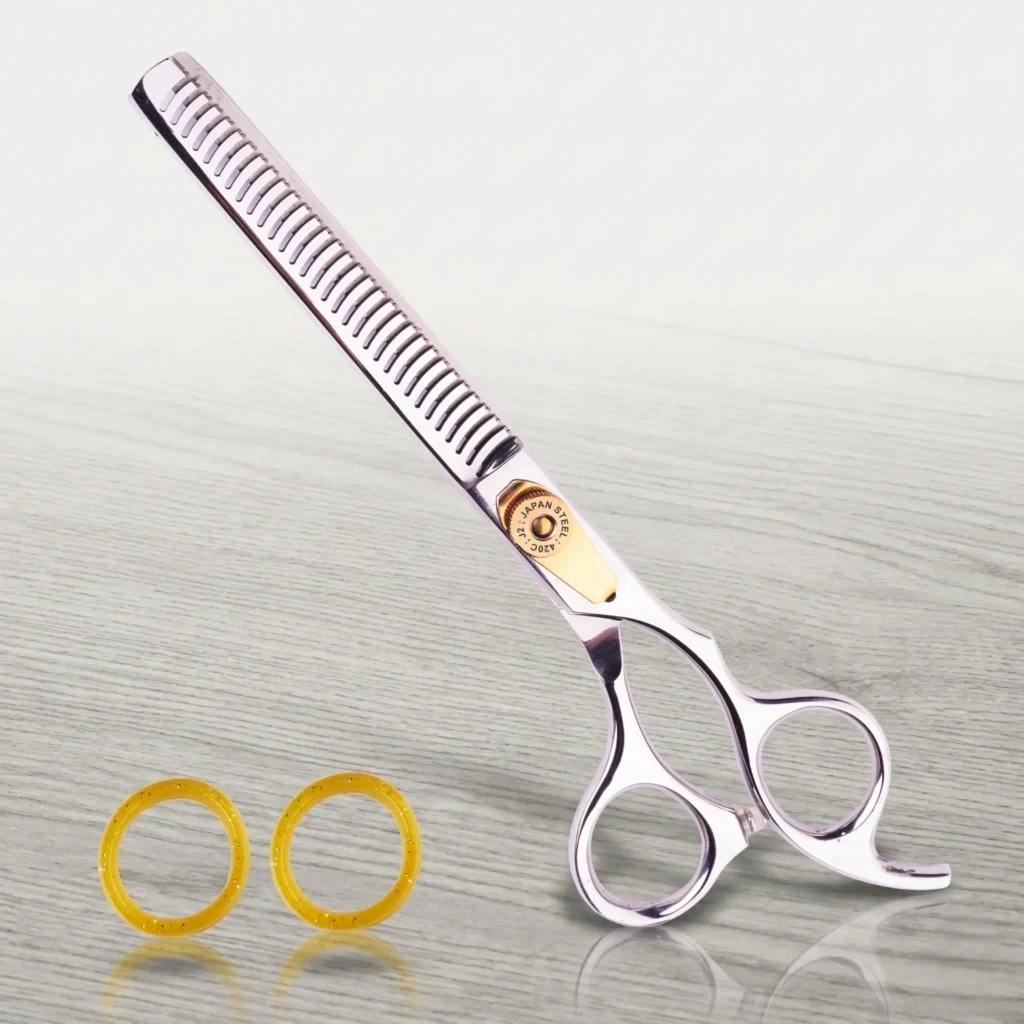
- Thinning and texturizing shears: One or both blades use teeth to remove only part of a section.
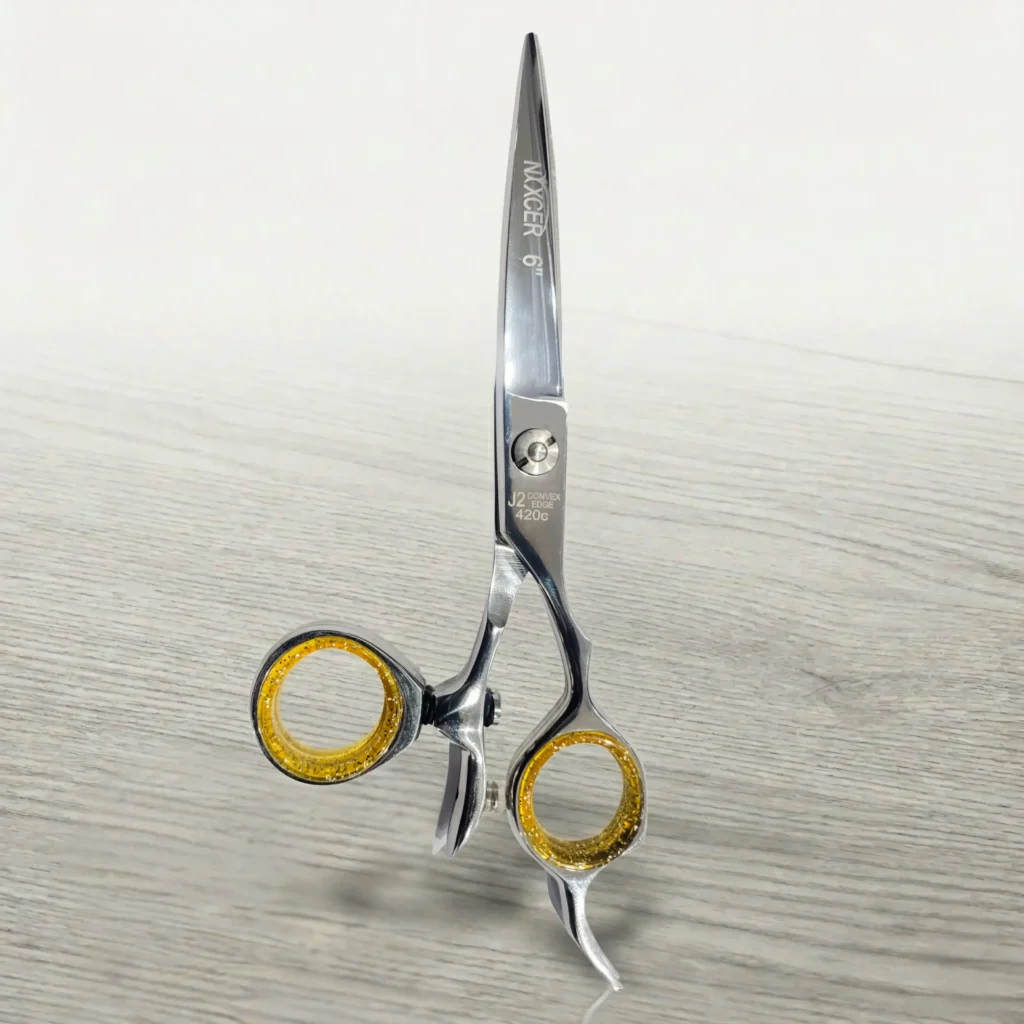
- Convex edges: Highly polished, curved edges support smooth cutting and techniques such as slicing or slide cutting.
- Beveled edges: Durable edge geometry offers grip and dependable general cutting.
- Adjustable tension: systems Stylists can tune blade pressure and movement.
- Offset and crane handles: Handle geometry helps reduce extreme wrist and thumb positions.
- Left-handed scissors: Reversed blades and handles give left-handed professionals a proper sight line and cutting action.
These changes turned the scissor from a general cutting implement into a family of specialized salon tools.
Japanese Influence on Modern Hair Cutting Scissors
Japan’s long blade-making tradition and modern specialty-steel industry strongly influenced premium hairdressing shears. Modern Japanese-style scissors are particularly associated with refined convex edges, smooth cutting action, careful heat treatment, and precise hand finishing.
“Japanese steel” is a broad commercial description rather than one universal grade. Performance depends on the actual alloy, heat treatment, blade geometry, manufacturing accuracy, and maintenance—not the country name alone. Still, steels and edge styles associated with Japanese shear production helped establish the smooth, high-precision cutting feel sought by many contemporary stylists.
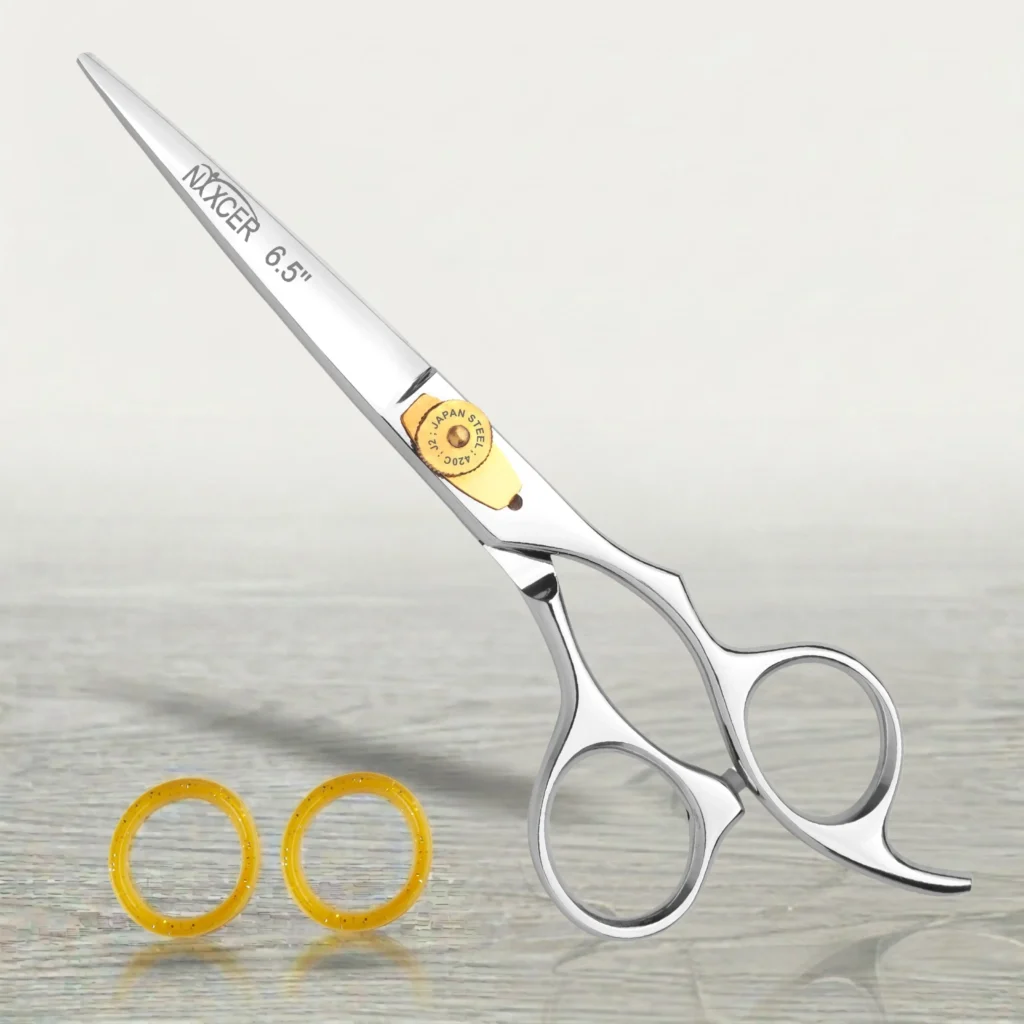
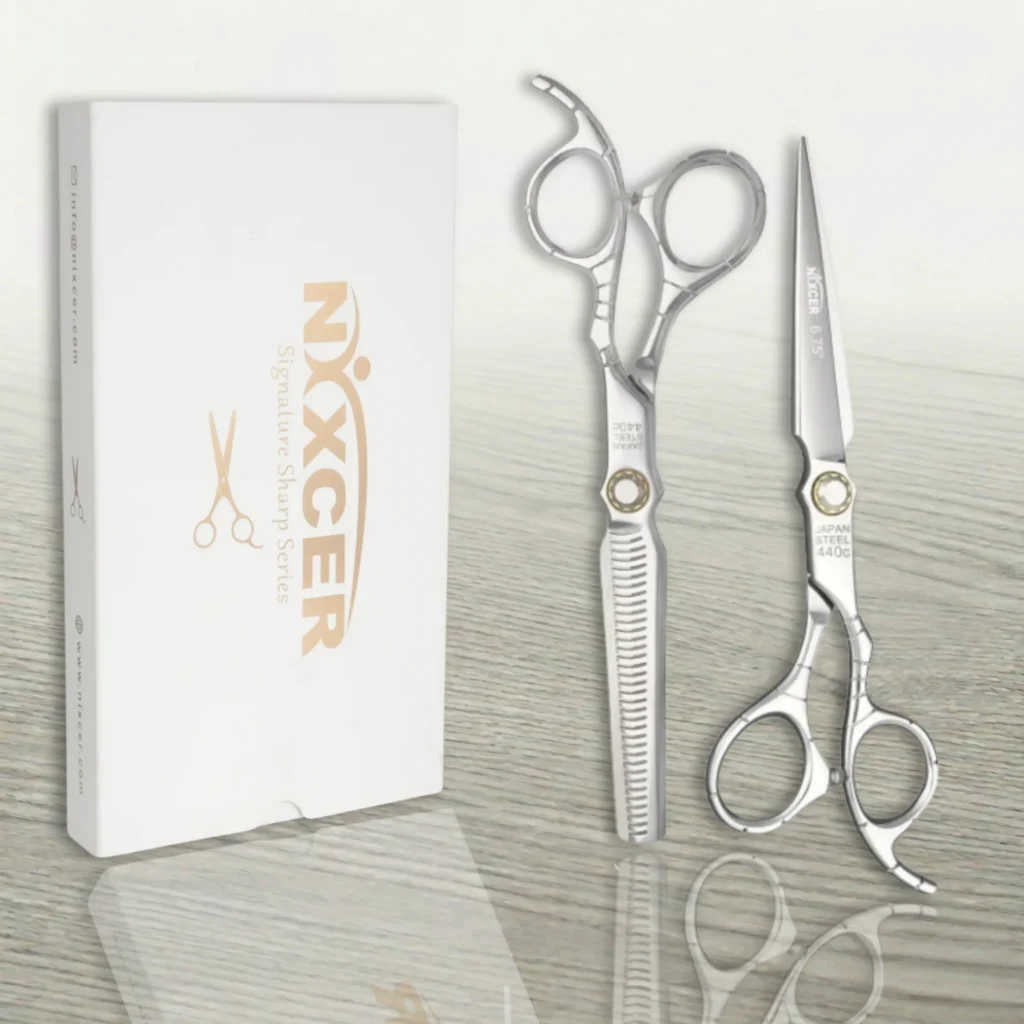
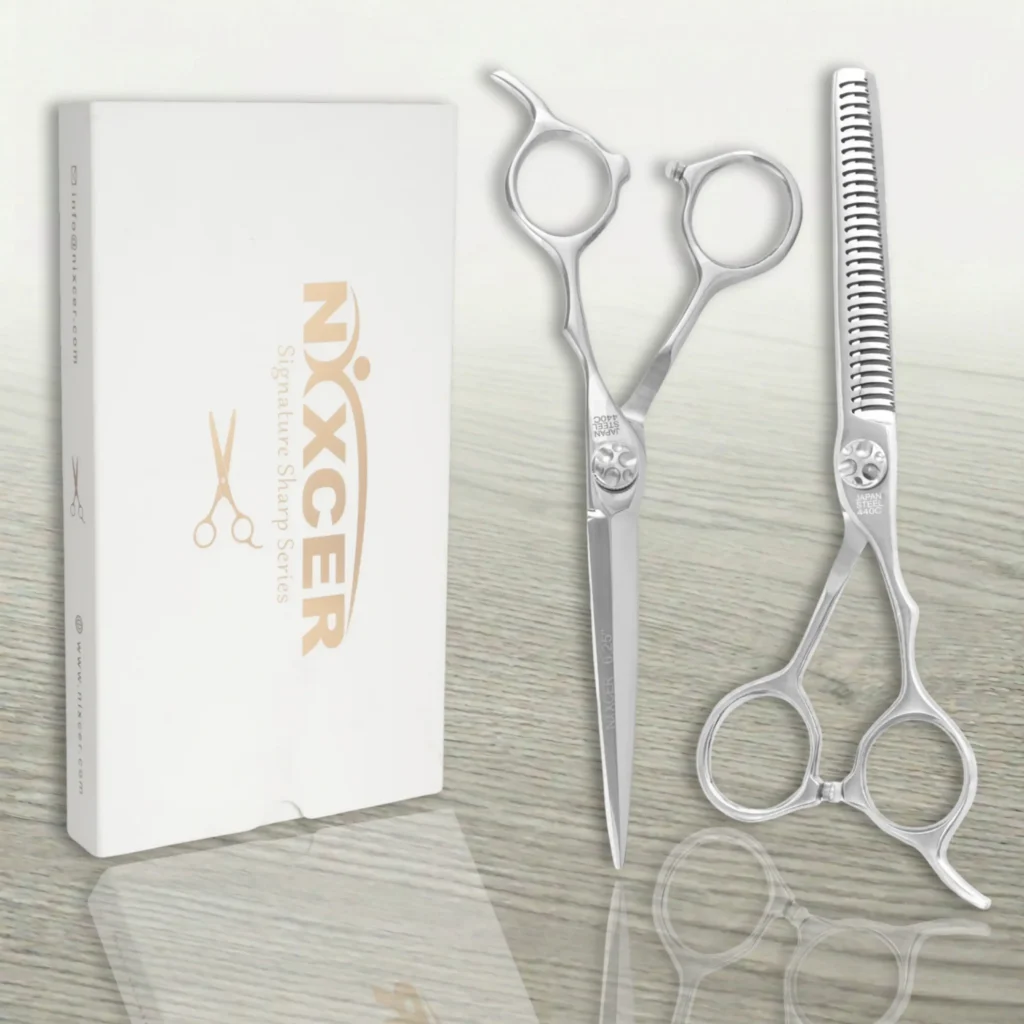
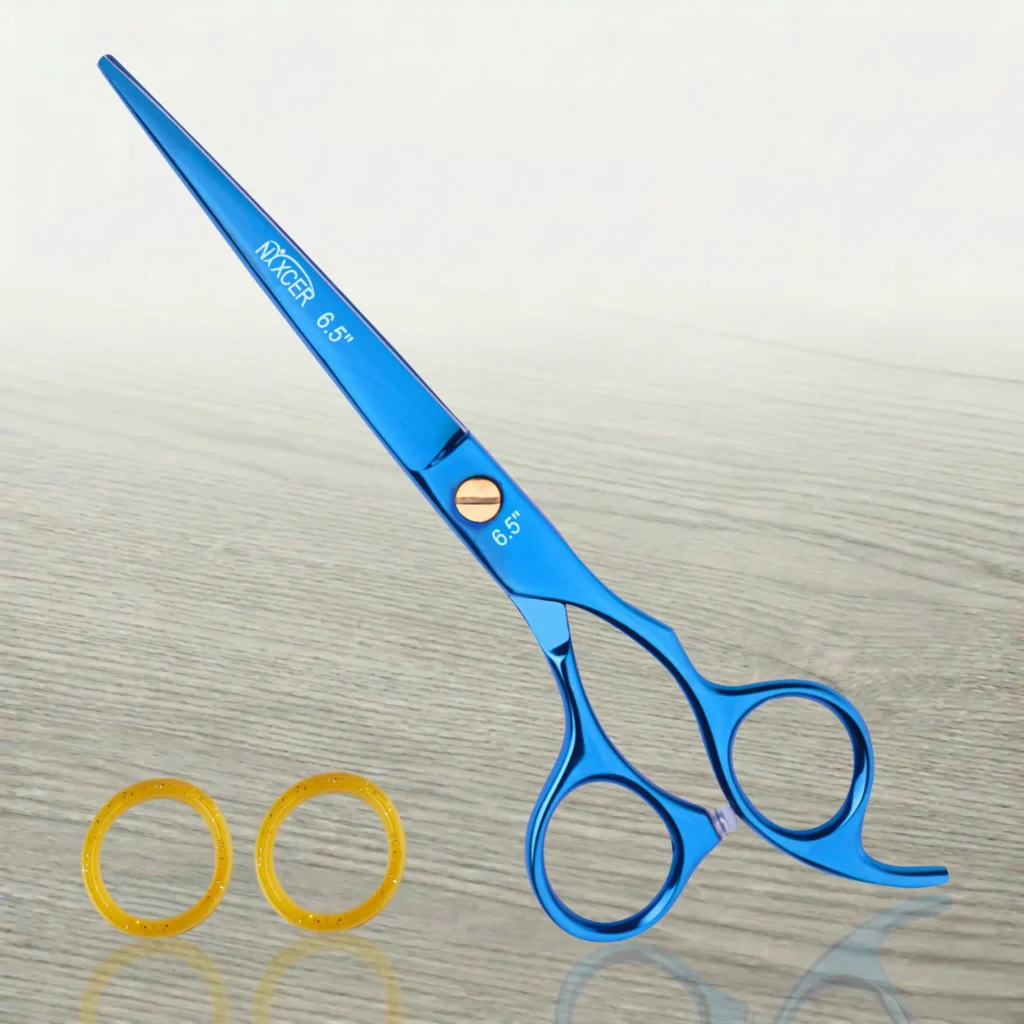
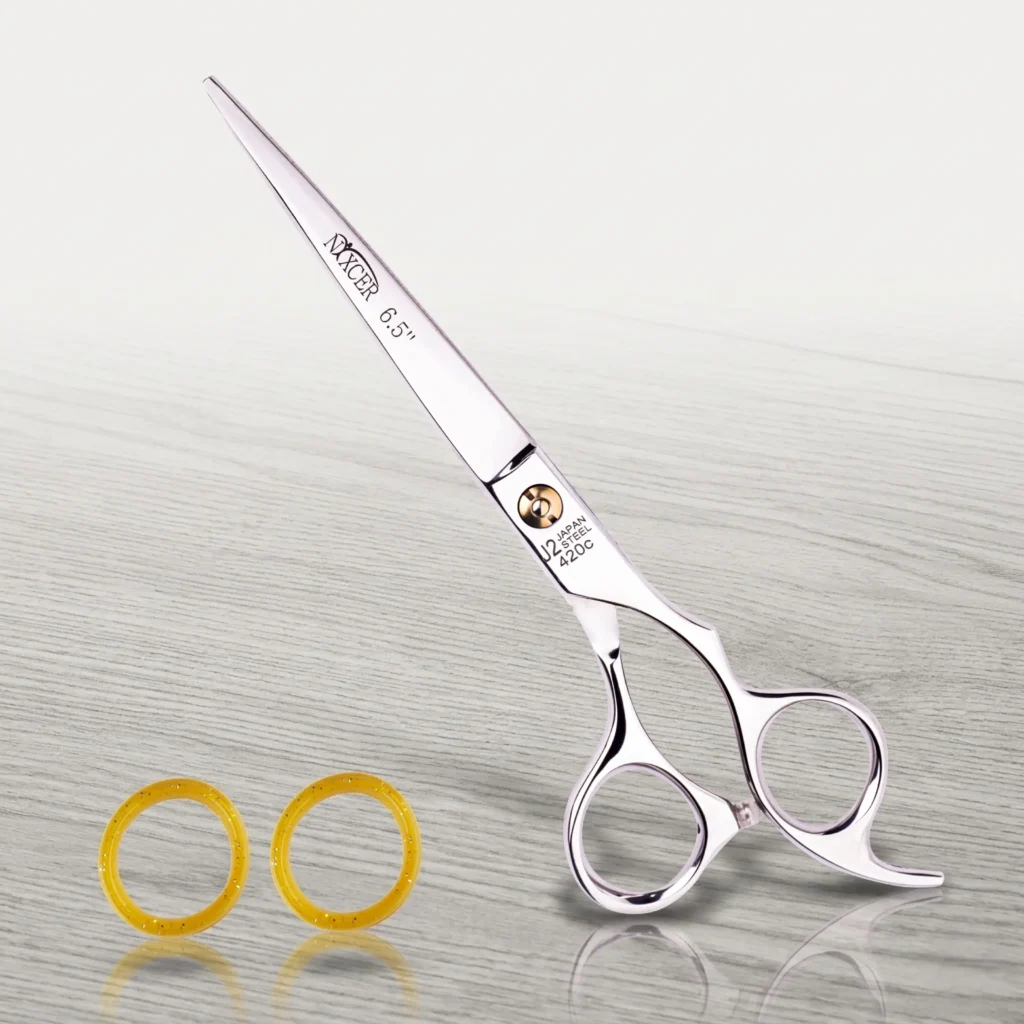
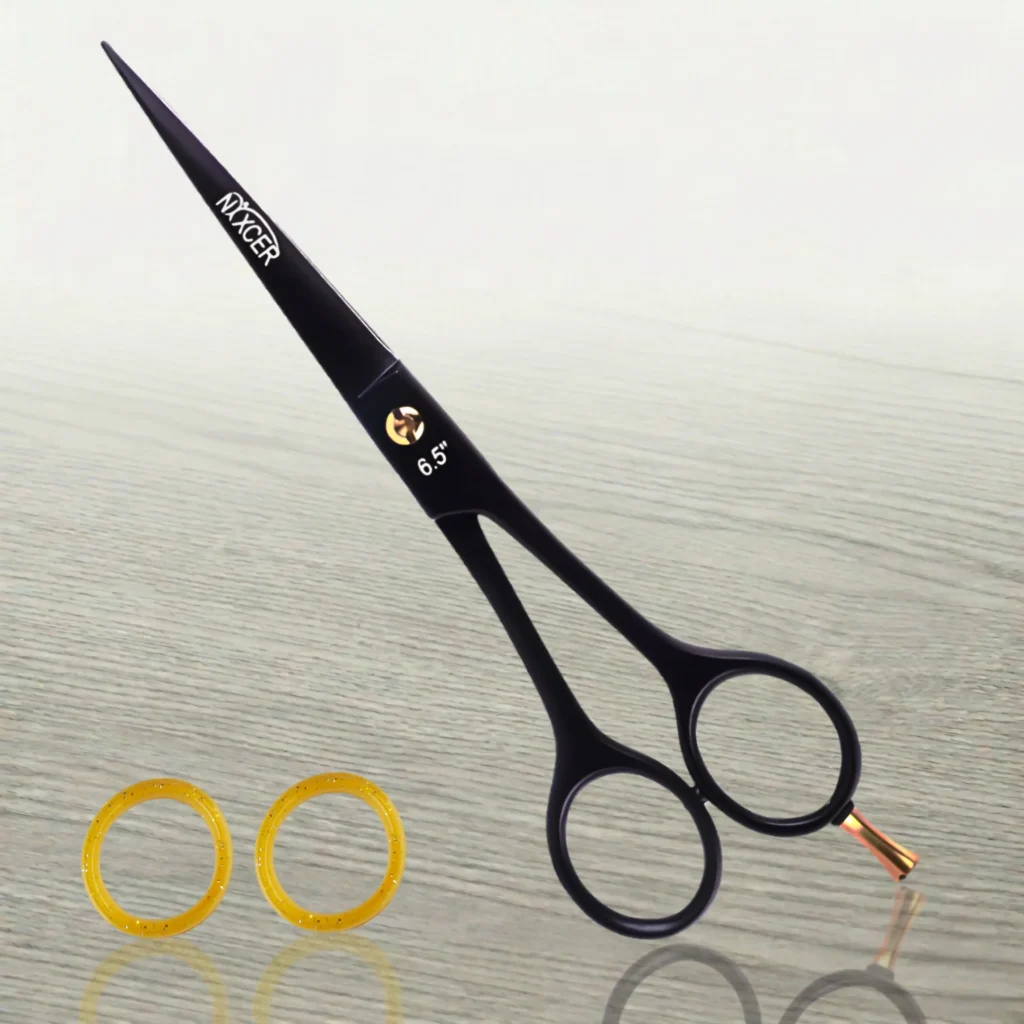
Nixcer Outlet’s Japanese steel barber scissors show how this history appears in a modern tool: a 6.5-inch format, adjustable pivot, offset handle, and steel selected for professional cutting.
How Modern Hair Cutting Scissors Differ From Ancient Shears
| Feature | Ancient or early shears | Modern professional hair scissors |
| Mechanis | Often a spring connection between blades | Precision pivot with adjustable tension |
| Materia | Bronze, iron, or early steel | Stainless and specialty alloy steels |
| Edg | General-purpose forged edge | Beveled, convex, semi-convex, or specialized toothed edge |
| Handl | Simple loop, bow, or spring form | Symmetric, offset, crane, or swivel ergonomic design |
| Primary us | Multipurpose cutting | Dedicated haircutting and texturizing techniques |
| Manufactur | Individually forged and filed | Forging or casting plus precision machining, heat treatment, and finishing |
The greatest difference is specialization. Ancient shears could cut many materials. Modern hair scissors are engineered around the diameter, flexibility, and behavior of hair, as well as the repeated hand movements of a working stylist.
Types of Hair Cutting Scissors Used Today
Modern professionals select scissors according to technique rather than expecting one pair to do everything.
Straight Cutting Scissors
These are the core salon and barbering tool. They handle blunt cutting, scissor-over-comb work, section cutting, and general shaping. Explore Nixcer Outlet’s full range of professional hair cutting scissors.
Thinning and Texturizing Scissors
Toothed blades remove selected hairs, helping reduce bulk, soften transitions, and add texture. They should refine an accurate haircut rather than compensate for poor sectioning. Browse professional hair thinning scissors.
Broad-Blade and Long Scissors
Longer or broader blades can increase stability through larger sections and support barbering techniques such as scissor over comb. The 6.25-inch Broad Blade Razor Edge Hair Cutting Scissors offer a modern example.
Cutting and Thinning Sets
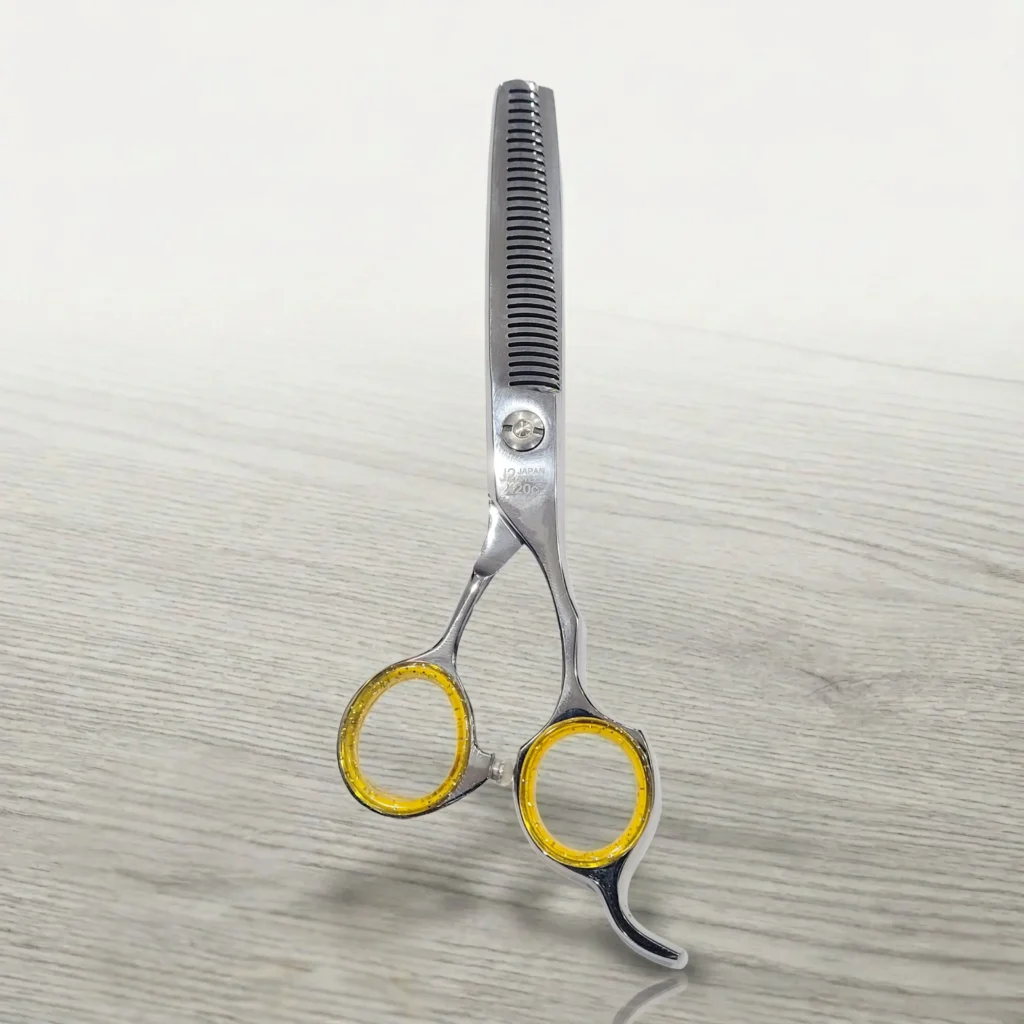
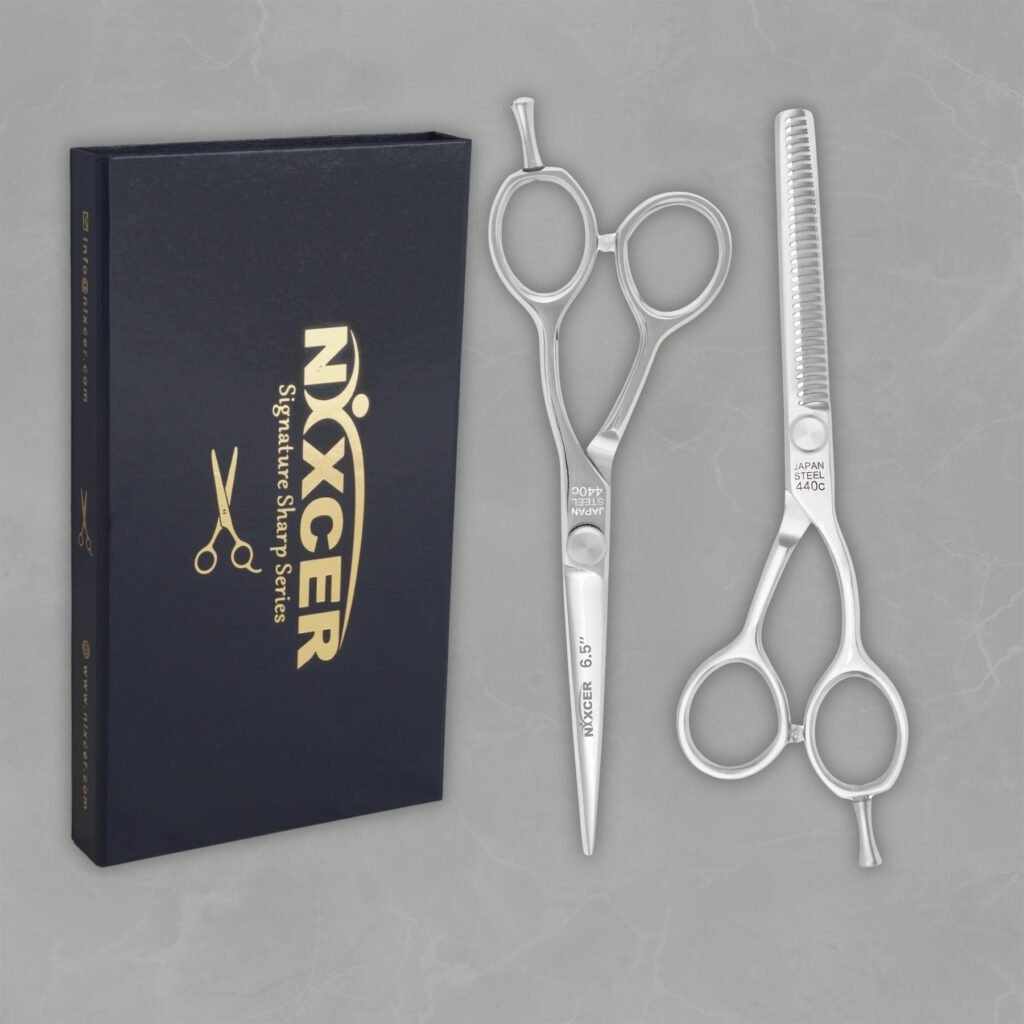
Matched sets give the stylist a cutting tool for structure and a toothed tool for refinement. Nixcer’s 6.5-inch cutting and thinning scissor set reflects the modern move toward technique-specific kits.
What Has Not Changed?
Despite thousands of years of development, the core goal remains simple: two edges must meet in controlled opposition and separate material cleanly. A premium alloy cannot compensate for poor blade alignment, incorrect tension, a damaged edge, or uncomfortable fit.
The human factor also remains central. Scissors are an extension of the hand. Their value depends on the stylist’s technique, maintenance habits, and ability to choose the right design for the task.
To compare modern selection factors such as blade design, size, steel, and ergonomics, read How to Choose Hair Cutting Scissors for Bob Cuts.
Frequently Asked Questions
Who invented hair cutting scissors?
No single person can be identified as the inventor of hair cutting scissors. Spring shears developed in the ancient world, while pivoted scissors also appeared in antiquity. Dedicated professional hair shears evolved gradually through centuries of metalworking and barbering.
When were scissors first invented?
Early spring shears are commonly dated to the Bronze Age, with examples or traditions often associated with the second millennium BCE. The exact origin is uncertain because similar tools developed across multiple regions and many surviving objects were multipurpose.
Did ancient Egyptians use scissors to cut hair?
Ancient Egyptians practiced extensive grooming and used blades, razors, and scissor-like tools. However, it is difficult to prove that every early pair of shears was specifically made for hair. Historical claims should distinguish general cutting tools from dedicated hairdressing scissors.
Did the Romans invent pivoted scissors?
Pivoted scissors were known in the Roman world, but saying that one Roman inventor created them around a precise year oversimplifies the evidence. The mechanism developed in antiquity and existed alongside spring shears.
Why is Sheffield important in scissor history?
Sheffield became a major center of steel, cutlery, grinding, and scissor production. Eighteenth-century cast steel and specialized manufacturing helped producers make hardened, polished scissors more consistently and at larger scale.
When did stainless steel hair scissors appear?
Stainless steel was developed in the early twentieth century and gradually adopted for many cutting instruments. Its corrosion resistance and compatibility with precision manufacturing made it important for modern salon shears.
What makes modern hair scissors different from ordinary scissors?
Professional hair scissors use blade geometry, edge finishing, balance, pivot tension, and ergonomic handles designed specifically for cutting hair. Ordinary household scissors may bend, crush, or push hair because they are made for different materials.
Why are Japanese-style hair scissors popular?
They are associated with refined convex edges, smooth cutting action, precise finishing, and high-quality specialty steels. Actual performance still depends on the specific alloy, heat treatment, construction, and maintenance.
Final Thoughts
The history of hair cutting scissors is not a straight line from one inventor to one modern tool. It is a long process of shared innovation: ancient spring mechanisms, Roman and medieval pivoted forms, blacksmithing and grinding traditions, Sheffield steel, industrial production, stainless alloys, Japanese-style edge refinement, and modern ergonomic design.
Today’s professional shears carry all of that history in a compact instrument built for accuracy and control. Shop Nixcer Outlet’s professional scissors to compare modern cutting, thinning, and combination designs.